In my two decades turning wrenches in performance shops, few sounds raise an eyebrow faster than a supercharger making noise. That high-pitched whine? Some folks call it music. But when it changes—gets louder, turns into a squeal, or comes with a hiss—it’s time to dig in. I’ve seen more than a few engines sidelined because someone either ignored the noise or jumped straight to tearing into the supercharger without proper diagnosis. Let’s walk through what I’ve learned.
Internal Supercharger Failures
When the noise is a consistent whine that rises with engine RPM, the problem is likely inside the supercharger. These issues are serious and can lead to catastrophic engine damage if ignored. Always inspect drive components first—many noises mimic internal failure—but if the drive belt and accessories check out, it’s time to look inside.
Rotor Pack Wear or Bearing Failure
On positive displacement superchargers like Eaton M-series units, rotor contact or bearing wear are the most common internal failures. Worn rotors create a high-pitched whine; failing bearings often produce a low growl or rumble that worsens under load.
How to Check: Remove the drive belt and manually rotate the supercharger pulley. Use a borescope through the intake port to inspect rotor lobes for scoring, pitting, or chipping. Feel for binding, notchiness, or rough rotation. Any resistance or noise during rotation is a red flag.
Pass/Fail Criteria: Radial play over 0.002 inch (0.05 mm) or visible damage to rotors or shafts indicates failure. Check your model’s service manual—some aftermarket units allow slightly more tolerance, but factory units are strict.
Cost & Viability: Rebuilding a rotor pack or replacing internal bearings requires a clean room, precision tools, and OEM specs. A remanufactured unit costs $800–$1,500; full replacement can run $1,800–$3,000. For most DIYers and shops, replacement beats in-house rebuilds for reliability.
In my shop, we never rebuild rotor packs in-house. Contamination during reassembly is the #1 cause of premature failure. We send units to certified rebuilders and use OEM-spec lubricants only.
Gear Set Wear (Oil-Filled Units)
Superchargers like the Eaton M112, M122, or TVS-series use an internal gear train bathed in lubricant. If the oil breaks down or gears wear, you’ll hear a grinding or whirring noise under load.
How to Check: Drain the gear oil and inspect for metallic glitter or a burnt smell. Rotate the pulley slowly and feel for excessive lash—more than a few degrees of free play before the rotors engage.
Pass/Fail Criteria: Any metal flakes in the oil or visible gear tooth pitting means internal damage. Backlash over 0.005 inch (0.13 mm) is usually unacceptable.
Solution: Gear replacement isn’t a field repair. It requires timing alignment, backlash measurement, and proper break-in. Send the unit to a specialist.
Coupler or Isolator Failure
Some superchargers (e.g., M90, M112) use a rubber or plastic coupler between the pulley and rotor shaft. Heat cycling and age cause cracking or chunking, leading to a clunk on throttle tip-in or inconsistent rotation.
How to Check: With the engine off, rotate the pulley and watch the rotors. If the pulley turns more than 1/8 revolution before the rotors move, the coupler is worn. Confirm with a borescope.
Solution: Replacement is DIY-friendly. Couplers cost $40–$80 and require front cover removal. Torque fasteners to spec—overtightening warps the housing.
Drive System Failures
Most supercharger noises aren’t from the blower itself—they’re from the drive system. These are easier and cheaper to fix, but often overlooked. Always rule these out before disassembling the supercharger.
Drive Belt, Tensioner, and Pulleys
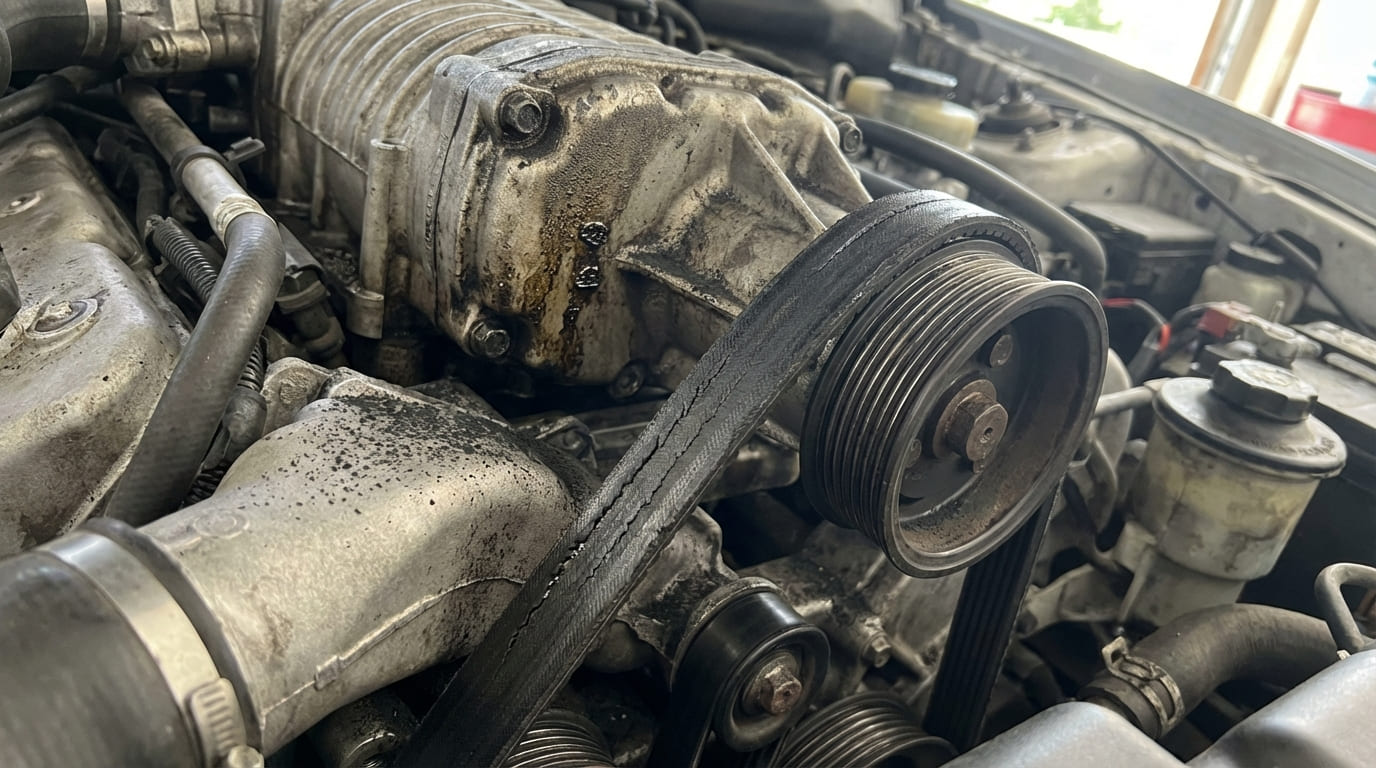
A glazed, cracked, or loose belt squeals under acceleration. A failing tensioner or seized idler pulley causes similar noise and accelerates belt wear.
How to Check:
- Inspect the belt for rib wear, cracking, or shine (glazing = slippage).
- Remove the belt and spin each idler and tensioner pulley by hand. Listen for roughness or grinding.
- Check tensioner arm movement—should be smooth and damped, not jerky or stiff.
- Use a dial indicator to measure supercharger pulley runout—over 0.010 inch (0.25 mm) is excessive.
Pass/Fail Criteria:
| Component | Acceptable | Fail Condition |
|---|---|---|
| Belt Tension (typical) | 180–220 lbs (new) | <140 lbs (worn) |
| Tensioner Bearing Play | None | >0.005 inch radial play |
| Idler Bearing | Smooth, quiet | Roughness or wobble |
| Pulley Runout | <0.010 inch | >0.010 inch |
Cost & Solution: Belts cost $30–$60, tensioners $80–$150, idlers $20–$50. Always replace the belt with the tensioner. Use a proper tension gauge—guessing leads to repeat failures.
On a 2006 GTO with a loud whine, I assumed internal bearing failure. Pulley spun smooth, rotors looked clean. Then I checked the tensioner—felt gritty. Replaced it, and the noise vanished. Moral: always test drive components first. It’s cheaper and often the real culprit.
Induction System Leaks
Leaks in the intake system create hissing or whistling noises that mix with the normal supercharger whine. These are aerodynamic, not mechanical, but can mimic internal failure.
How to Check: Perform a smoke test with the engine off. Focus on:
- Intake manifold gaskets (between blower and manifold)
- Vacuum lines, especially boost-referenced ones
- Intercooler seals (on TVS units with integrated coolers)
Pass/Fail Criteria: Any smoke escaping indicates a leak. On vacuum lines, look for cracks, softness, or disconnections. Leaks that only appear under heat or pressure may require simulated boost testing.
Solution: Replace gaskets or hoses. Use reinforced silicone in high-heat areas. For intercooler seals, a light coat of high-temp RTV can help prevent micro-leaks, though OEM specs may not call for it.
A 2013 Camaro SS had a chirping noise under boost. Belt and pulleys were perfect. Smoke test revealed a tiny crack in a bypass valve vacuum line. Fixed the hose, noise gone. Lesson: not every noise is mechanical. Rule out airflow issues before tearing into the supercharger.
Diagnosis and Safety
Correctly identifying the noise type and source prevents wasted time and money. Use these guidelines to prioritize repairs.
Noise Characteristics and Likely Causes
- Constant whine rising with RPM: Internal—bearings, rotors, gears.
- Squeal on acceleration: Belt slippage—check tension, wear, tensioner.
- Hissing with whine: Induction leak—perform smoke test.
- Clunk on throttle tip-in: Worn coupler or loose pulley.
Stethoscope Use for Source Isolation
Use a mechanical stethoscope to pinpoint the loudest point: supercharger housing, tensioner, idlers, intake manifold. But be cautious—vibration can transmit through brackets and mislead you. Always verify with component removal or smoke testing.
Risk Levels and Recommended Actions
Not all noises are equally dangerous. Prioritize repairs based on risk:
| Failure Type | Risk Level | Probable Consequence | Recommended Action |
|---|---|---|---|
| Internal Rotor/Bearing Wear | High | Debris entering engine, hydro-lock, piston damage | Minimize RPM, avoid boost, repair immediately |
| Drive Belt or Tensioner Failure | Medium-High | Loss of alternator, water pump, or power steering | Inspect daily, replace at first sign of wear |
| Induction System Leak | Medium | Lean condition, high EGTs, catalyst damage | Repair within days, monitor fuel trims |
| Idler or Pulley Bearing Noise | Low-Medium | Progressive belt wear, eventual failure | Replace within a few hundred miles |
A customer replaced his supercharger twice after a persistent whine. I checked the crankshaft pulley—it had 0.018 inch runout. The misalignment was destroying belts and stressing the blower shaft. Lesson: never replace parts without diagnosing the root cause. Measure pulley alignment and crank harmonics first.
Best Practices: Do and Don’t
- ✅ Do: Use a stethoscope and smoke tester before disassembly. Saves time and avoids misdiagnosis.
- ✅ Do: Inspect gear oil on applicable units. A quick drain can reveal metal before catastrophic failure.
- ✅ Do: Measure pulley runout and alignment. Even 0.005 inch can cause noise and wear.
- ⚠️ Don’t: Reuse torque-to-yield fasteners on supercharger covers. They’re one-time-use and can cause leaks or warpage.
- ⚠️ Don’t: Guess belt tension. A proper gauge costs less than a ruined alternator.
- ⚠️ Don’t: Ignore small vacuum leaks. Under boost, they can flow enough air to lean out the engine.
Every supercharger noise isn’t a death sentence. But every one deserves a methodical look. I’ve saved customers thousands by catching a $20 idler pulley before it took out a $2,000 blower. The key is to treat each symptom as a clue, not a verdict. And when in doubt? Consult the factory service data—specs vary more than you’d think between model years and applications.