I’ve spent over two decades behind the lift, turning noise complaints into clear diagnoses. Every sound tells a story—some are cheap fixes, others are early warnings of major failure. Let’s break down the most common engine noises with a mechanic’s eye: what to check, how to test, and whether to repair or replace.
Knocking, Detonation, Pinging
These metallic knocks under load—like accelerating uphill—are often mistaken for mechanical failure. But in many cases, the issue is combustion-related and reversible. True mechanical knocks are deeper, rhythmic, and worsen with RPM and load.
How to Check: Detonation vs. Mechanical Knock
Start with a road test: accelerate in a higher gear at low RPM. If the ping occurs under load and stops when you ease off, it’s likely detonation. If the knock persists at idle or varies with RPM, suspect mechanical wear.
- Low-octane fuel: Check the fuel cap or manual—many engines require 91+ octane. Switch to top-tier fuel and retest. Cost: $5–$10 more per fill-up. Worth it to prevent long-term damage.
- Carbon buildup: Common in direct-injection engines. Use a professional fuel system cleaner or walnut blasting. Borescope inspection through a spark plug hole confirms deposits. Cost: $150–$300.
- Lean air/fuel mixture: Scan for fuel trims. STFT above +10% indicates a lean condition. Check for vacuum leaks, dirty MAF sensor, or clogged injectors. A smoke test is the best way to find leaks.
- Faulty knock sensor: Use a scan tool to check for knock sensor activity. Some systems show real-time voltage. Tap near the sensor with a wrench—ECU should register knock and retard timing. No response? Sensor may be faulty. Replacement: $80–$250, depending on location.
For mechanical knocks—deep, low-frequency, under load—proceed with caution. These often mean bearing wear.
- Connecting rod bearing knock: Loudest at mid-RPM under load. Use a stethoscope on the lower engine block. If silencing one cylinder stops the noise, that rod bearing is likely bad. Low oil pressure supports the diagnosis, but normal pressure doesn’t rule it out.
- Main bearing knock: More centralized, often felt through the firewall. Doesn’t isolate to one cylinder. Check oil pressure—consistently low (below 20 psi at idle) is a red flag.
- Piston slap: Cold-start noise that fades as engine warms. Common in aluminum-block engines. Not usually harmful, but monitor for progression. If it persists when hot, consider piston or cylinder wear.
- Flex plate or torque converter: Noise changes with transmission load (e.g., worse in Drive than Neutral). Inspect through the inspection cover. Look for cracks or loose bolts. Repair cost: $300–$800 if converter needs replacement.
In my shop, we never condemn an engine based on sound alone. We check oil pressure, perform cylinder contribution tests, and use a stethoscope systematically. A $100 diagnostic saves thousands in unnecessary teardowns.
Ticking, Clicking, Tapping
Rhythmic, high-frequency tapping is usually valvetrain-related. The key is determining whether it’s normal operation or a sign of wear.
How to Check: Valvetrain Noise Diagnosis
Start the engine cold. If the noise fades within 30 seconds, it’s likely oil-related. If it persists, remove the valve cover for visual inspection—especially on engines with known cam wear issues.
- Hydraulic lifter collapse: Common in high-mileage engines. Try switching to a higher viscosity oil (e.g., 5W-30 to 10W-30). If noise remains, check oil pressure. Clogged lifters or sludge may require replacement. Cost: $200–$600 for lifter replacement, depending on engine design.
- Valve lash (solid lifters): Requires manual adjustment. Use a feeler gauge per manufacturer specs. Incorrect lash causes noise and accelerated wear. Always adjust cold unless specified otherwise.
- Camshaft lobe wear: Flattened lobes cause lifter collapse and ticking. Visible during valve cover removal. If one lobe is shiny and rounded, it’s worn. Repair requires cam replacement—$1,000+ in parts and labor.
- Timing chain tensioner failure: Rattle at startup, especially on cold mornings. Hydraulic tensioners fail due to sludge. Inspect oil condition. If the chain jumps time, engine damage follows. Replace tensioner and guide rails as a set. Cost: $600–$1,200.
Fuel injectors and exhaust leaks can mimic valvetrain noise.
- Fuel injectors: Normal ticking is expected. If one is significantly louder, it may be clogged or failing. Swap injectors and retest. Cleaning may help, but replacement is often needed. Cost: $15–$50 per injector.
- Exhaust leak: Check for soot stains at manifold gaskets. Noise is often worse when cold. Use a stethoscope or hose to pinpoint. Repair with new gaskets or manifold bolts. Cost: $100–$300.
I once diagnosed a “lifter tick” as cam wear only after removing the valve cover. The lifters looked fine—but the cam lobes were flat. Always inspect the whole system. Replacing lifters without fixing the root cause is a waste.
Whistling, Hissing
High-pitched air noises usually mean leaks—either vacuum or boost. These affect performance, fuel economy, and emissions.
How to Check: Air Leak Diagnosis
Use a smoke machine for vacuum leaks. Pressurize the intake system and watch for smoke escaping. For boost leaks, use a leak tester to pressurize the intake up to 20 psi.
- Vacuum leaks: Common sources: PCV hose, brake booster line, intake gaskets. Smoke testing is the gold standard. Propane or carb cleaner sprays can work but are less reliable and risky near hot components.
- Intake manifold gaskets: Some seal both vacuum and coolant. A leak may cause overheating or white smoke. Check for coolant traces in the smoke test.
- Boost leaks: Frequent in turbocharged engines. Focus on intercooler hoses, clamps, and charge pipes. A 5 psi drop during testing confirms a leak. Repair with new hoses or clamps. Cost: $20–$100 for parts.
- Turbo bearing wear: Check for axial play (more than 0.003″) or radial play (over 0.006″). But noise can also come from compressor surge—listen for flutter, not grinding. Oil in the intake pipe suggests turbo failure.
A turbo hiss turned out to be a $12 split hose. We pressurized the system—found it in 10 minutes. Don’t assume the turbo is blown. Test the whole system before quoting a $2,000 repair.
Humming, Squeaking
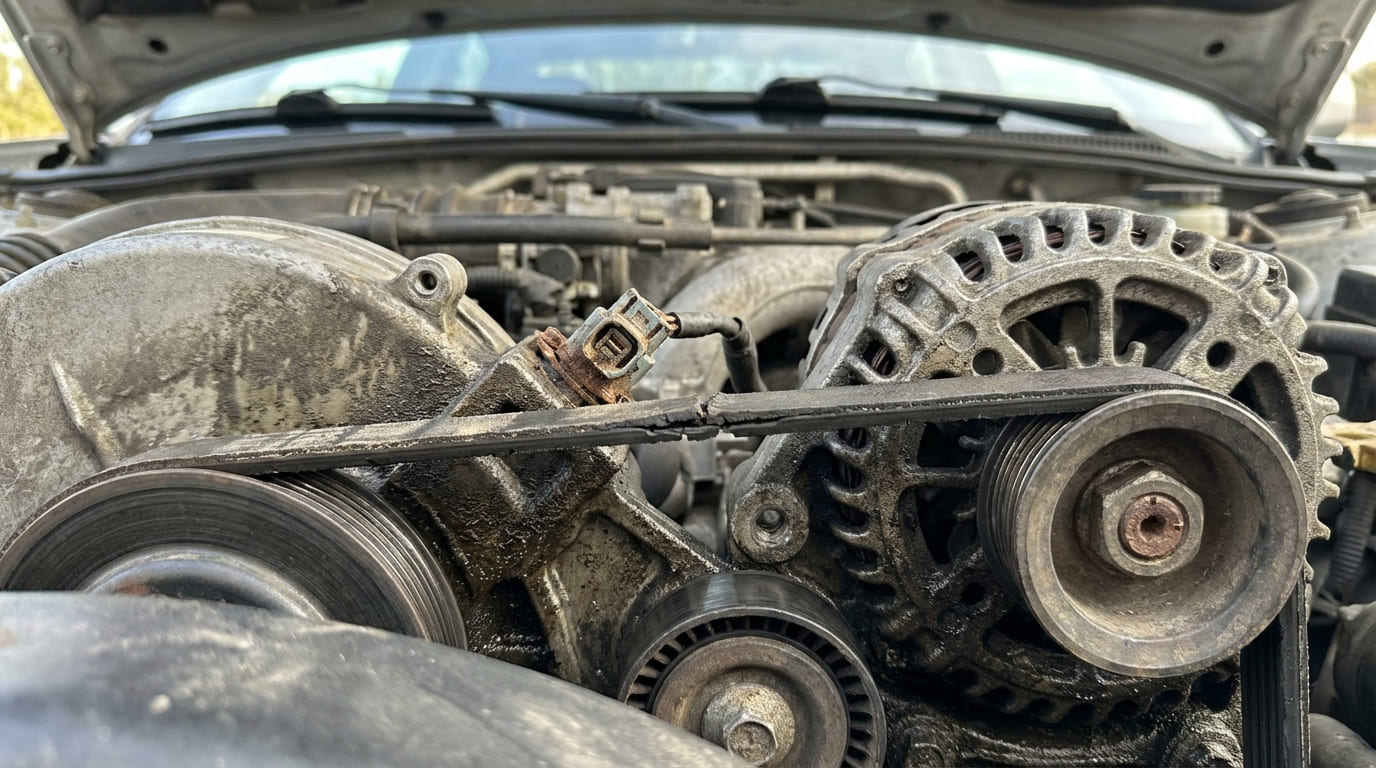
These noises are often belt- or bearing-related. The challenge is isolating which accessory is at fault.
| Noise Type | Most Likely Cause | Less Common But Possible | Diagnostic Tip |
|---|---|---|---|
| High-pitched squeal | Worn serpentine belt | Glazed pulley, misaligned tensioner | Wet the belt—squeal disappears temporarily if belt is the issue |
| Bearing hum | Idler pulley or tensioner bearing | Alternator, water pump | Remove belt, spin each pulley by hand. Gravelly feel means replacement needed |
| Intermittent squeak | AC compressor clutch | Power steering pump | Engage/disengage AC. Noise that comes and goes with clutch cycling points to AC |
| Whine under load | Power steering pump | Low fluid, kinked hose | Check fluid level and condition first. Whine that fades with steering input suggests pump wear |
Not all hums are engine-related. A failing torque converter bearing can hum in Drive but not Neutral. Manual transmissions may have input shaft bearing noise that changes with clutch pedal pressure.
A deep knock turned out to be two loose torque converter bolts. We pulled the inspection cover—fixed in 20 minutes. Always rule out external rotating parts before tearing into the engine.
Recommended & Avoid Practices
- ✅ Recommended: Use a smoke machine for vacuum leaks. It’s safer and more accurate than propane testing. Explains fuel trim issues and rough idle.
- ✅ Recommended: Clean bolt threads with a tap before reinstalling. Burrs or debris affect torque accuracy, especially on aluminum components.
- ⚠️ Avoid: Reusing torque-to-yield (stretch) bolts. They lose clamping force after first use. Replacement cost is low—don’t risk head gasket failure.
- ⚠️ Avoid: Diagnosing bearing knock by sound alone. Combine stethoscope, oil pressure test, and cylinder cutout for accuracy.
- ✅ Recommended: Record noise signatures on known-good engines. Helps detect subtle changes during future visits.
Cylinder head flatness is critical during reassembly. Most specs allow 0.002″ to 0.004″ over 6 inches, but performance engines may require 0.0015″. Use a precision straight edge and feeler gauges—check multiple directions.
In my shop, we don’t rush. We test, verify, and cross-reference. A knock sensor code might mean real detonation, not a bad sensor. A ticking lifter could be the first sign of oil starvation that’ll kill a camshaft.
Final advice: always consult the factory service manual. Tolerances, torque specs, and design details vary. What’s normal on one engine is a failure sign on another.