Replacing an exhaust manifold is a common but labor-intensive repair. As a master mechanic and automotive editor, I’ve seen this job range from straightforward to nightmare-level complex—depending on your vehicle. This guide cuts through the noise and delivers exactly what you need: real-world costs, how to diagnose the issue, what to expect during repair, and whether it’s worth fixing or replacing.
Total Cost Range
For most vehicles, expect to pay between $400 and $1,500 for a professional exhaust manifold replacement. Jobs on performance, turbocharged, or European models can exceed $3,000 due to complexity and parts cost. The majority of mainstream vehicles (like Honda, Toyota, Ford) fall in the $600–$900 range with quality aftermarket or OEM-equivalent parts.
In my shop, we always quote a range—not a flat rate—because rust, broken bolts, and hidden damage can turn a 3-hour job into 8 hours fast. Always build in a 20% buffer when budgeting.
Cost Breakdown
Parts Costs
Parts alone can range from $200 to over $1,500, depending on design and materials.
| Part | Cost Range | Notes |
|---|---|---|
| Exhaust manifold (cast iron) | $150 – $400 | Common on older or base models. Prone to cracking under thermal stress. |
| Tubular stainless steel manifold | $300 – $800 | Better heat control, used in performance applications. More expensive to replace. |
| Manifold with integrated catalytic converter | $500 – $1,500+ | Major cost driver. Found on modern engines for emissions compliance. |
| Gasket kit | $20 – $100 | Includes head-to-manifold and downpipe gaskets. MLS gaskets require precise surface finish. |
| Hardware kit (bolts/studs) | $15 – $75 | TTY (torque-to-yield) bolts must be replaced. Reuse risks leaks or breakage. |
| Oxygen sensor (HO2S) | $50 – $250 | Often seized in manifold. Replace if damaged during removal. |
| Heat shields | $30 – $150 | Prevent heat damage to wiring and cabin. Replace if warped or missing. |
Labor Costs
Labor is the biggest variable. Access determines time, and time determines cost.
- Typical labor hours: 2–8 hours
- Inline-4 engines: 2–4 hours (better access)
- V6/V8 engines (especially transverse): 6–8+ hours
- Turbocharged or DOHC engines: often require intake/turbo removal
- Hourly rate: $80–$200
- Independents: $80–$120
- Dealerships/urban shops: $130–$200+
- Diagnostic time: 0.5–1.5 hours (sometimes billed separately)
I once had a twin-turbo V6 that took 14 hours just to remove the intake and turbos to reach the manifold bolts. That labor alone was $2,100 at $150/hour. Always ask: “What has to come off to reach the manifold?” before approving the job.
Key Factors That Affect Cost
Why does the same repair cost $600 on one car and $2,500 on another? These four factors explain nearly all variation.
Vehicle Design and Engine Layout
Access is everything. Boxer engines (Subaru) allow undercar access but risk head damage. Transverse V6 engines often require alternator, power steering pump, or halfshaft removal. Inline engines (4-cyl) are usually easiest.
Manifold Material and Integration
Cast iron cracks easily but is cheap. Stainless steel resists cracking but costs more. Integrated catalytic converters can double or triple the part cost—and they’re often the reason for replacement.
Geographic Location and Shop Type
A job in rural Kansas may cost $700. The same job in Los Angeles or NYC can hit $1,200+ due to higher labor rates and OEM part usage at dealerships.
Additional Repairs Found During Disassembly
Once the manifold is off, you might find:
- Broken or seized bolts
- Cracked flanges or cylinder head damage
- Melted O2 sensor wiring
- Corroded downpipe or flex joint
These often add $100–$400 to the final bill. That’s why I always advise customers: “Assume something else will need fixing once we’re in.”
How to Diagnose a Failing Exhaust Manifold
Don’t guess. Confirm the problem before authorizing repair. Here’s how to check—whether you’re DIYing or verifying a shop’s diagnosis.
Symptoms of Failure
- Ticking or hissing noise on cold start – Often goes away as metal expands
- Exhaust smell in cabin – Especially during deceleration when intake vacuum draws fumes
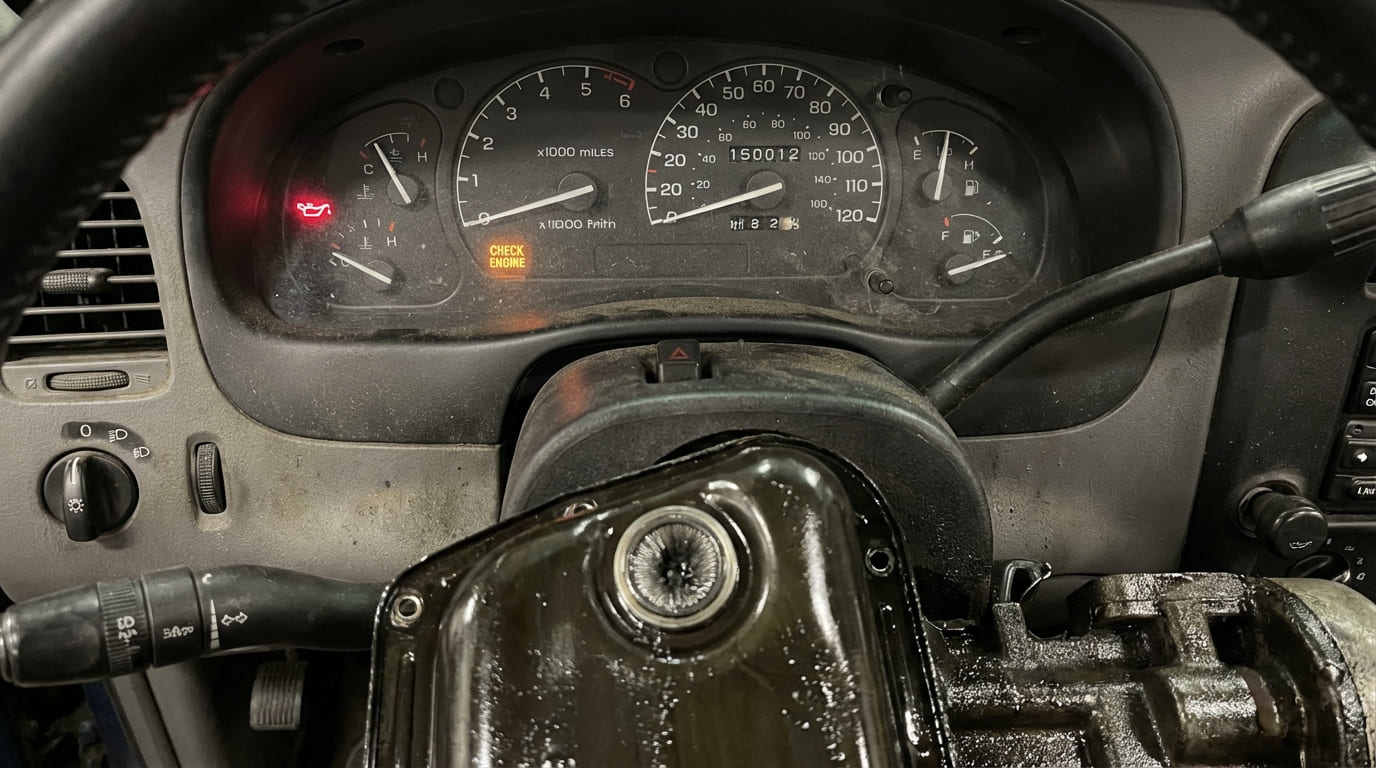
- Check Engine Light with lean codes (P0171, P0174) – Unmetered air entering pre-O2 sensor
- Poor fuel economy and rough idle – ECU adding fuel to compensate for false lean condition
- Failed emissions test – High HC or NOx from leaks or failing integrated cat
How to Check: Step-by-Step Diagnosis
- Visual inspection: Use a mirror and flashlight. Look for soot trails, cracked flanges, or warped metal. Check heat shields and nearby wiring for heat damage.
- Stethoscope or vacuum hose test: With engine cold, listen along the manifold. A ticking or puffing sound confirms a leak. Focus on gasket seams and bolt areas.
- Smoke test: Seal the tailpipe, introduce low-pressure smoke into the exhaust system. Watch for smoke escaping at the manifold. Most reliable method.
- Check for codes: Use a scan tool. P0420 may indicate failing integrated cat. P0171/P0174 suggest pre-sensor air leak.
- Exhaust gas analysis (EGA): Sample near suspected leak. Elevated HC or CO confirms exhaust escape.
Never assume a ticking noise is a bad lifter. I’ve saved customers hundreds by ruling out valvetrain issues with a 10-minute smoke test. Always verify the source before disassembling major components.
Can You Repair Instead of Replace?
Short answer: rarely. Here’s what actually works—and what doesn’t.
Welding Cracks
Welding cast iron manifolds requires pre-heating, controlled cooling, and post-weld tempering. Even then, thermal cycling often causes re-cracking. In my experience, welded manifolds fail again within 6–12 months. Not worth it on high-heat engines.
Resurfacing Warped Flanges
Minor warpage (<0.005") can be milled flat. But this thins the flange and reduces clamping strength. I’ve seen resurfaced manifolds leak again within a year—especially on turbo applications. Replacement is safer.
I only consider repair for rare or discontinued manifolds. For common vehicles, replacement with a quality aftermarket or OEM part is faster, more reliable, and often cheaper long-term.
Risks of Delaying Replacement
Ignoring a bad manifold leads to bigger problems:
- Carbon monoxide in cabin: Can cause dizziness, headaches, or worse. A cracked manifold near the firewall is especially dangerous.
- Engine damage: Lean conditions increase combustion temps, risking piston or valve damage.
- Wiring and component damage: Radiant heat can melt harnesses, vacuum lines, or plastic intake parts.
- Failed emissions test: Leaks or failing cats will fail inspection in regulated states.
Recommended Practices and Common Mistakes
Whether you’re doing it yourself or supervising a shop, follow these proven tips.
- ✅ Use a bottoming tap to clean bolt threads. Ensures accurate torque and prevents thread damage—especially in aluminum heads.
- ✅ Always install new gaskets and hardware. Modern gaskets are precision-engineered. TTY bolts stretch—reusing them risks leaks.
- ✅ Apply anti-seize to stud threads (not the flange). Prevents seizing but keep it off the gasket surface to maintain clamping force.
- ⚠️ Never reuse torque-to-yield (TTY) bolts unless specified. They’re designed to stretch. Reuse leads to under-torque and failure.
- ⚠️ Don’t over-tighten to stop a leak. Can warp flanges or strip threads. Find the real cause instead.
- ⚠️ Avoid RTV sealant on factory gasketed joints. Most modern gaskets are designed to work dry. RTV can create new leak paths.
Diagnostic Scenarios and Real-World Causes
| Symptom | Most Likely Cause | Less Common But Possible | Diagnostic Next Step |
|---|---|---|---|
| Ticking noise on cold start, disappears when warm | Exhaust manifold crack or loose bolt | Valve train noise, heat shield rattle | Stethoscope test + visual with mirror |
| O2 sensor code (P0171) + exhaust smell | Exhaust leak pre-O2 sensor | Intake vacuum leak, faulty MAF | Smoke test intake and exhaust separately |
| P0420 with integrated catalytic converter | Failing integrated cat | Downstream O2 fault, misfire history | EGA test + check for misfires or oil consumption |
| Visible soot trail at manifold-to-head junction | Failed gasket or warped flange | Cracked manifold, improper torque | Remove heat shield, check flatness with straight edge |
Situation: 2012 Ford F-150, 4.6L V8, cold-start ticking. Customer thought it was a lifter.
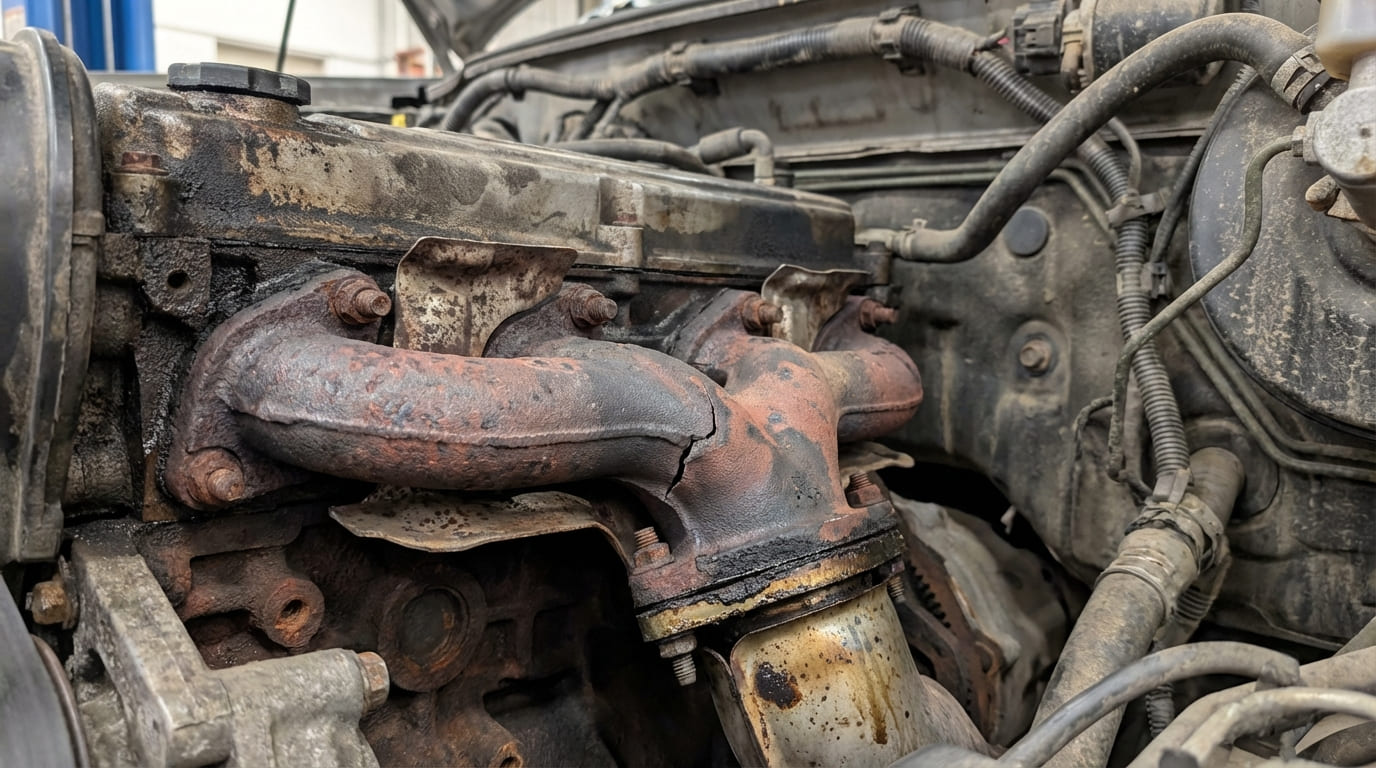
Discovery: Stethoscope ruled out valvetrain. Smoke test revealed leak at rear of passenger-side manifold. Found hairline crack near cylinder 5.
Lesson: Not every ticking noise is internal. Exhaust leaks mimic mechanical issues. Always verify before disassembling.
Situation: 2015 Subaru Outback, P0420 after rear cat replacement. Code returned in two weeks.
Discovery: EGA and backpressure test showed restriction. Removed manifold—integrated cat was melted from unburned fuel due to cylinder 3 misfire (caused by leaking intake gasket).
Lesson: Catalyst failure is often a symptom, not the cause. Fix the root issue or it’ll come back.
Situation: 2008 Honda Accord, exhaust smell in cabin. No codes, no noise.
Discovery: Smell worsened during deceleration. Smoke test was clean. Found small crack near firewall—fumes drawn into HVAC intake under vacuum.
Lesson: Not all leaks are loud or visible. Consider airflow and driving conditions during diagnosis.
Always consult your vehicle’s service manual for torque specs, tightening sequence, and flange flatness limits. What works on one engine can damage another. When in doubt, trust a technician who specializes in your vehicle type.