In my shop, I’ve heard more than a few owners describe a high-pitched whistle or a faint hiss coming from the engine bay—especially noticeable at idle or under light load. While some folks jump straight to “blown gasket,” the reality is more layered. Over two decades turning wrenches, I’ve found that exhaust leaks can mimic other issues, and not every whistle means teardown time. Let’s walk through what I actually check when that noise shows up.
Primary Causes of Exhaust Manifold Whistling or Hissing
The core issue behind most whistling or hissing sounds near the exhaust manifold is pressurized exhaust gas escaping through a restricted opening. The smaller the gap, the higher the pitch—hence the whistle. Below are the most common sources I see, ranked by frequency and repair complexity.
1. Exhaust Manifold Gasket Failure
This is the most common cause, especially on high-mileage engines or those with frequent cold starts. Thermal cycling breaks down the gasket over time, leading to a leak at the cylinder head interface.
How to Check: Start with a cold engine. Look for soot trails or a “carbon zebra stripe” along the manifold-to-head seam. Use a mechanic’s stethoscope or a length of vacuum hose to your ear, moving it close to each exhaust port while the engine idles—listen for a sharp increase in hissing. For confirmation, spray soapy water on the joint; bubbles will form at the leak. On V-engines with tight clearance, a smoke test is more reliable.
Repair vs Replace: Replacing the gasket is usually cost-effective—$15–$50 for the part, but labor can run $200–$500 depending on accessibility. If the manifold is corroded or warped, replacement may be necessary.
Master Tip: Always clean both mating surfaces thoroughly with a gasket scraper and wire brush. Leftover material causes improper sealing. Torque bolts in a cross pattern to OEM specs—many modern engines use torque-to-yield (TTY) bolts that must be replaced, not reused.
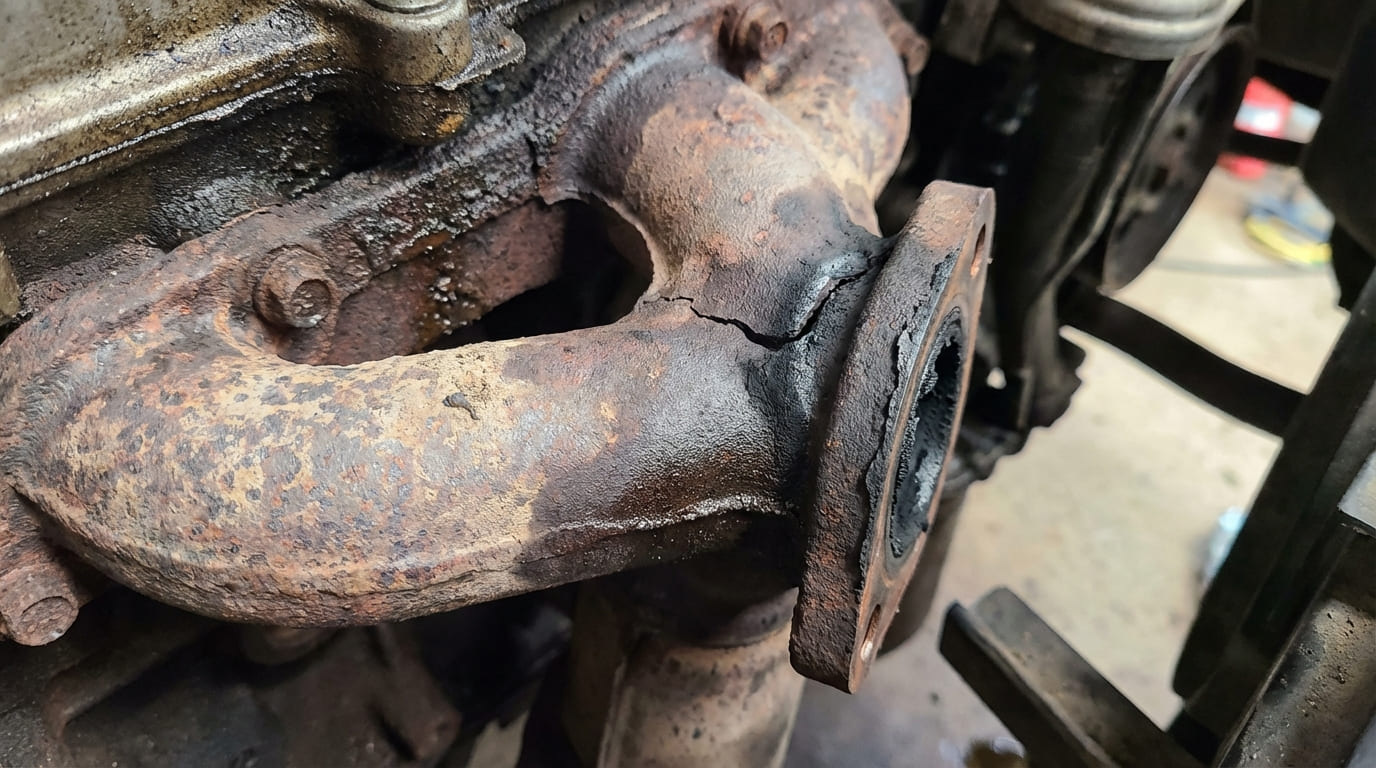
2. Cracked Exhaust Manifold
Cast iron manifolds crack due to thermal stress, especially near ports or bends. Stainless steel headers can crack from sudden cooling. Cracks may be invisible when hot—they close under expansion.
How to Check: Inspect cold with a bright LED light and a magnifying mirror. Focus on high-stress zones: sharp bends, near studs, and around ports. Use a stethoscope to pinpoint hissing along the manifold body. Confirm with a smoke test.
Repair vs Replace: Replacement is usually the best long-term fix. Welding is possible but often fails again due to residual stress and repeated heating. Cost varies: $150–$600 for the manifold, plus $200–$600 labor. If the manifold is integrated with the catalytic converter, expect $1,000+—double-check diagnosis first.
In my shop, we always inspect the manifold for cracks before replacing the gasket. I’ve seen too many come back with the same noise because the root cause wasn’t addressed.
3. Loose, Broken, or Stripped Fasteners
Manifold bolts can loosen from vibration or improper installation. On aluminum heads, stripped threads are common. A broken stud flush with the head complicates removal.
How to Check: Use a torque wrench to verify bolt tightness—don’t rely on feel. If a bolt spins freely or won’t reach spec, suspect stripped threads. Remove the bolt and inspect with a flashlight; cross-threading or corrosion are telltale signs.
Repair vs Replace: Replace broken bolts. For stripped threads in aluminum, use a thread repair kit like Time-Sert or Helicoil. If multiple threads are damaged, pulling the head may be necessary. DIY cost: $20–$100 for tools and inserts. Shop labor: $300–$800 if head removal is needed.
Never torque manifold bolts on a hot engine. Heat changes metal expansion and can lead to over-clamping or warping. Always work cold.
4. Downpipe or Catalytic Converter Gasket Leak
The leak may not be at the head—it could be downstream at the manifold-to-downpipe flange. The noise travels forward, sounding like it’s near the engine.
How to Check: Inspect the lower flange for soot buildup. Use the stethoscope method at idle. These gaskets often use a metal “donut” seal—look for distortion or crushing.
Repair vs Replace: Gaskets cost $15–$40. Replacement is simpler than head-side work, but rusted bolts can double labor time. If flanges are warped, resurfacing or replacement is needed.
5. EGR or Oxygen Sensor Leaks
Accessories mounted to the manifold can leak too. A loose O2 sensor, cracked EGR pipe, or failed EGR valve gasket all produce similar sounds.
How to Check: Inspect O2 sensors—ensure they’re tight (typically 30–50 Nm, but check specs). Look for soot around the bung. For EGR, check gaskets and pipe connections. A loose heat shield near the sensor can also whistle—don’t overlook the obvious.
Repair vs Replace: O2 sensor gaskets or anti-seize (used sparingly) often fix the issue. Sensors themselves cost $50–$150; EGR valves $100–$300. Labor varies by location.
I once chased a P0420 code and a whistle for weeks. Turned out the upstream O2 sensor wasn’t torqued properly. Fixed with a torque wrench and a dab of anti-seize on the threads—no parts replaced.
Diagnostic Techniques That Work
Don’t rely on sound alone. Use a system to confirm the leak location and avoid unnecessary disassembly.
When to Test: Cold vs Hot Engine
Start cold—small cracks or gasket gaps are often more pronounced. You can safely probe and spray. But recheck at operating temperature: some leaks only appear when hot. Always let the engine cool before touching anything.
Tools That Make a Difference
A flexible inspection mirror and LED light are essential. For stubborn leaks, consider UV dye: inject it into the exhaust stream, then scan with a UV light. Dye accumulates at leak points, even in shadowed areas.
Scan Tool and Gas Analysis
If the leak is upstream of the upstream O2 sensor, the ECU may detect excess oxygen and show positive long-term fuel trims (e.g., +10% or higher). A 5-gas analyzer showing O2 levels above 0.8% before the cat can support the diagnosis—but rule out secondary air injection first, which also raises oxygen during warm-up.
Best Practices Checklist
- ✅ Clean bolt threads with a bottoming tap before reassembly—ensures accurate torque and clamp load.
- ✅ Use new OEM-spec gaskets. Aftermarket rubber-coated versions often compress too much or degrade quickly.
- ✅ Torque in stages using the OE pattern—usually a spiral from center outward on 4-cylinders.
- ⚠️ Never reuse torque-to-yield (TTY) bolts unless the manual explicitly allows it. Stretch alters their properties.
- ⚠️ Avoid sealant on exhaust gaskets unless specified. Most modern gaskets are designed to seal dry.
- ⚠️ Don’t over-tighten to stop a leak. This can warp flanges or strip threads—making repairs much harder.
Flatness and Warpage Specs
Before reassembly, check manifold and head flange flatness. Use a straightedge and feeler gauge. Typical limits:
| Engine Type | Max Warpage (inches) | Measurement Method |
|---|---|---|
| Cast Iron Block | 0.002–0.004 | Across entire flange |
| Aluminum Head | 0.0015 | Over any 2-inch span |
Always consult the factory service manual—tolerances vary by engine. If warpage exceeds spec, resurface or replace the component.
Common Leak Scenarios and Likely Causes
| Symptom / Observation | Most Probable Cause(s) | Less Common But Possible Causes |
|---|---|---|
| Whistle at idle, disappears under load | Gasket leak at manifold-to-head joint | Loose O2 sensor, EGR pipe leak |
| High-pitched hiss only when cold | Small crack that closes when hot | Loose fastener expanding into place |
| Soot trail at downpipe flange | Downpipe gasket failure | Manifold warpage affecting alignment |
| O2 sensor code + hissing | Loose or damaged O2 sensor | Cracked bung weld, upstream exhaust leak |
| Noise near EGR valve | EGR valve or pipe gasket leak | Internal valve diaphragm failure |
Real-World Case Studies
Situation: 2010 V6 SUV with a sharp whistle at idle. Owner replaced the manifold gasket twice—noise returned.
Diagnosis: Smoke test revealed bubbles at the upstream O2 sensor bung weld—a hairline crack that only opened when cold.
Lesson: Replacing a gasket doesn’t fix a cracked casting. Always verify the leak location after repair.
Situation: Turbo 4-cylinder hissing under boost. Assumed downpipe gasket leak.
Diagnosis: Smoke test showed no flange leak. Crack found in manifold near cylinder #2, hidden under a heat shield.
Lesson: Sound travels through metal. Isolate sections methodically—don’t assume the loudest point is the source.
Situation: Whistle and poor fuel economy. Long-term trims at +18%.
Diagnosis: No exhaust leak. Torn intake boot confirmed with propane test. Whistle was a loose heat shield.
Lesson: Correlation isn’t causation. Diagnose intake and exhaust systems independently.
Exhaust manifold noises often lead us down familiar paths, but I’ve learned to stay open-minded. A whistle might be a $20 gasket—or a cracked casting hiding under a bracket. The key is systematic verification: see it, hear it, test it. And never skip the service manual. The specs in your head might be close, but the ones on paper are the only ones that matter for that particular engine.