In my shop, I’ve seen DTCs lead to a quick fix and also send technicians down a three-day diagnostic rabbit hole. The difference? Understanding that codes are clues, not confessions. Over two decades, I’ve learned that how you interpret a DTC often matters more than the code itself. Let’s break down the real-world process of working with diagnostic trouble codes—the way it’s done when the clock is ticking and the customer expects a lasting repair.
Understanding DTC Types and What They Mean
OBD-II standardized the format, but not the behavior. Codes fall into four categories, each pointing to a different system. Knowing which type you’re dealing with helps narrow the scope before you even grab a tool.
P-codes relate to engine, transmission, and drivetrain—most common for drivability issues. B-codes cover body systems like airbags and lighting, but can indirectly affect engine operation. C-codes involve ABS, suspension, and steering, and can interfere with throttle or stability systems. U-codes indicate communication failures between modules, often on the CAN bus, and can mimic engine problems.
In my shop, we treat U-codes as critical—even if the engine runs fine. A U0100 (lost communication with ECM) might stem from a $5 fuse or a $500 module, but 9 times out of 10, it’s a wiring or power issue. Always check fuses and module grounds first.
Decoding the DTC Format: What Each Digit Tells You
Take P0171: “System Too Lean (Bank 1).” The code structure reveals the system and fault type:
- P: Powertrain
- 0: Generic (SAE-defined, not manufacturer-specific)
- 1: Fuel and air metering subsystem
- 71: Specific fault identifier
A P0300 (random misfire) points to combustion issues but doesn’t tell you why. It could be spark, fuel, compression, or even a vacuum leak. The code is a symptom, not the diagnosis. Never replace parts based on the code alone.
In my shop, we always say: “The code tells you where to look, not what to replace.” A P0171 might lead you to a $10 vacuum hose or a $300 fuel pump. Start cheap—inspect for leaks, check fuel pressure, and analyze fuel trims before buying parts.
How to Retrieve DTCs: Tools and Procedure
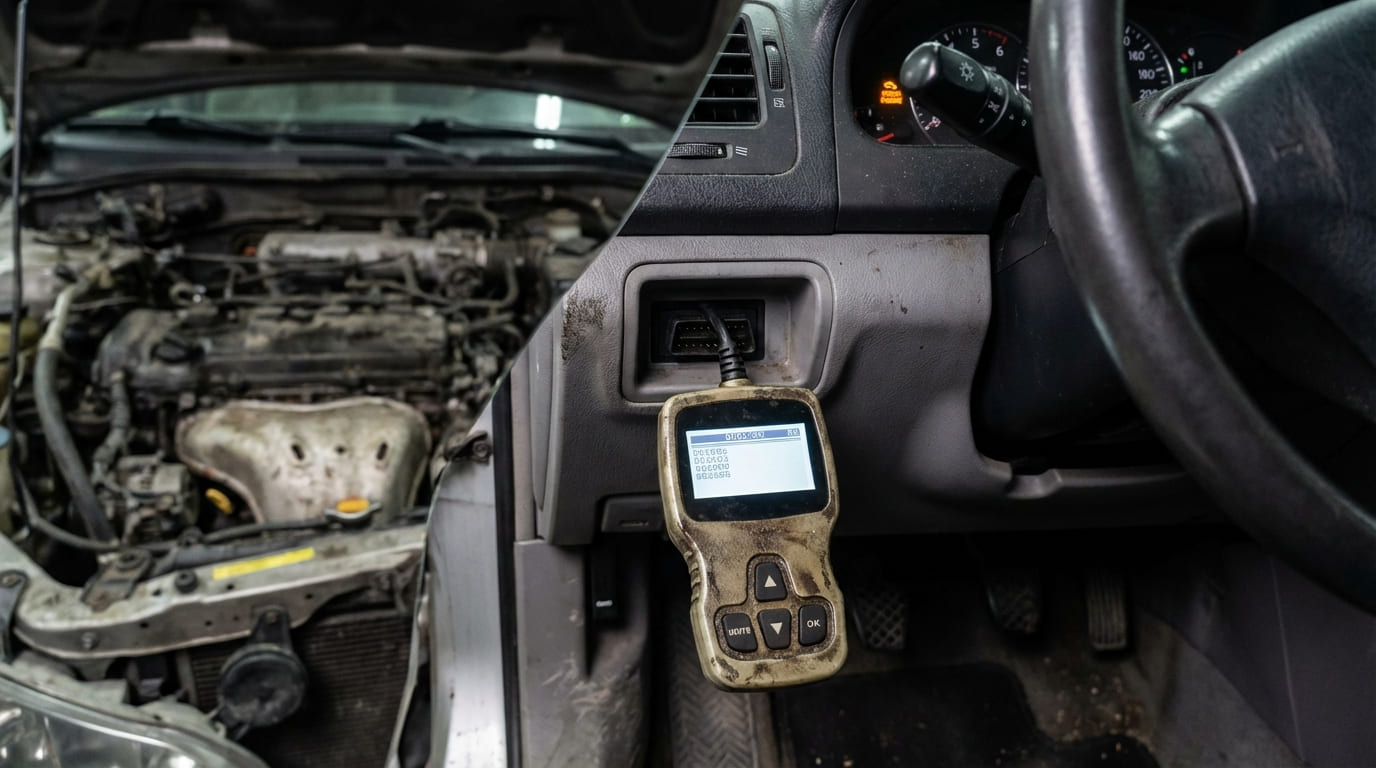
Start with a reliable OBD-II scanner. For basic code reading, a $30 generic tool works. But for serious diagnostics, invest in a scan tool that reads pending codes, freeze frame data, and live PIDs. OEM-level tools like TechStream (Toyota), IDS (Ford), or GDS (Honda) are worth it for complex issues.
Connect to the J1962 port—usually under the dash near the steering column. On some Ram and Jeep models, it’s behind the ashtray. Turn the ignition to “Key On, Engine Off” (KOEO) before scanning. Some older ECUs won’t respond otherwise.
Once connected, check three things:
- Stored codes: Confirmed faults that triggered the Check Engine Light.
- Pending codes: Detected once or twice—potential early warnings.
- Permanent codes: Hard-coded by the PCM. They’ll return until the system passes a full drive cycle, even after clearing.
Always note freeze frame data before clearing codes. It captures engine load, RPM, speed, and fuel trims at the moment the code set. I’ve used it to reproduce intermittent issues that only happen at highway cruising. Lose it, and you lose your best clue.
Interpreting DTCs: From Code to Root Cause
Multiple codes? Look for the root, not the symptoms. For example, P0101 (MAF performance) and P0171 (system lean) often appear together. A bad MAF can cause a lean code—but so can a vacuum leak. Don’t assume. Test both.
Pending codes deserve attention. A single P0302 (cylinder 2 misfire) might be a glitch. But if it returns over three drive cycles, it’s likely real—possibly a failing coil, dirty injector, or compression loss.
Use live data to validate sensor operation. Watch long-term and short-term fuel trims. If LTFT is over +10%, the engine is adding fuel—likely due to a vacuum leak or weak fuel delivery. If both banks are lean, suspect a shared issue like MAF or fuel pressure. If only one bank, look at injectors, O2 sensors, or exhaust leaks near the sensor.
Freeze Frame and Live Data: Your Best Diagnostic Allies
Freeze frame data tells you the conditions when the code set. Combine it with live data to test under the same load. For example, if a P0420 (catalyst efficiency) triggered at 45 mph and 1,800 RPM, recreate those conditions and watch downstream O2 sensor response. A lazy sensor will move slowly, mimicking a bad catalytic converter.
Test throttle position sensor (TPS) voltage: should sweep smoothly from 0.5V to 4.5V. But don’t trust the number alone—carbon buildup in the throttle body can cause hesitation even with perfect TPS readings. Always pair data with physical inspection.
Diagnostic Workflow: From Code to Fix
After retrieving codes, follow a methodical process to avoid misdiagnosis. Start with the most likely causes, but verify before replacing parts.
Step 1: Consult Service Information and TSBs
Manufacturer service manuals and Technical Service Bulletins (TSBs) are gold. A chronic P0171 on a Toyota 4Runner? A TSB likely points to a known intake manifold gasket issue. Revised gasket kits cost $25 and fix it permanently—no need to replace MAF or fuel pumps.
Aftermarket repair guides often miss model-specific quirks. OEM manuals include test procedures, torque specs, and diagnostic flowcharts you won’t find online.
Step 2: Perform Targeted Component Testing
Don’t guess—test. For electrical circuits, perform voltage drop tests across connectors. For sensors, compare live data to known good values. A MAP sensor might read “in range” at idle but fail under load. Dynamic testing reveals what static checks miss.
For misfires, use a scan tool to read individual cylinder misfire counts. If cylinder 3 is spiking, swap the coil with cylinder 1. If the misfire moves, it’s the coil. If it stays, it’s mechanical—check compression, injectors, or valves.
Step 3: Conduct a Thorough Visual Inspection
Never skip this step. Use a flashlight and mirror to inspect spark plug boots, vacuum lines, wiring harnesses, and grounds. I’ve found rodent-damaged wires, cracked hoses under the intake, and corroded ground straps on the firewall.
Smoke testing is invaluable for vacuum leaks. Pressurize the intake system and watch for smoke escaping. A small crack in a PCV hose can cause a P0171 only at idle—missed by fuel trim alone.
Best Practices: What to Do and What to Avoid
- ✅ Recommended: Clear codes only after repair and complete a full drive cycle. This resets monitors and confirms the fix.
- ✅ Recommended: Always check freeze frame data before clearing. It’s often the key to intermittent issues.
- ✅ Recommended: Use OEM service manuals for test specs. Aftermarket data can be inaccurate.
- ⚠️ Avoid: Replacing parts based solely on DTCs. A P0401 (insufficient EGR flow) is usually a clogged passage, not a bad EGR valve.
- ⚠️ Avoid: Ignoring pending codes. They’re early warnings—address them before they become hard faults.
- ⚠️ Avoid: Using cheap aftermarket sensors. I’ve seen $20 O2 sensors cause fuel trim issues within weeks. Stick with OEM or quality brands like Denso, NTK, or Bosch.
Common DTCs and Real-World Causes
| DTC Example | Most Likely Causes | Less Common But Possible | Diagnostic Priority |
|---|---|---|---|
| P0300 (Random Misfire) | Ignition coils, spark plugs, fuel injectors | Vacuum leak, low fuel pressure, cam timing | High – check live misfire counts first |
| P0171 (System Too Lean) | Vacuum leak, dirty MAF, clogged fuel filter | Failing fuel pump, exhaust leak pre-O2 sensor | High – verify with fuel trim analysis |
| P0420 (Catalyst Efficiency) | Aged catalytic converter, faulty O2 sensors | Engine oil contamination, chronic misfires | Medium – rule out sensor issues first |
| P0101 (MAF Sensor Performance) | Dirty or failing MAF, air leaks post-sensor | Wiring damage, incorrect MAF calibration | High – inspect intake tract thoroughly |
| U0100 (Lost Comms with ECM) | Power/ground issue, CAN bus short | ECM in failsafe, software glitch | Critical – check fuses and network resistance |
Real-World Diagnostic Case Studies
Situation: A 2015 Honda Accord came in with a P0171 and rough idle. Previous shop replaced the MAF and air filter.
Initial Assumption: Lean condition due to faulty intake air measurement.
Deep Dive: Live data showed long-term fuel trim at +28% at idle, normalizing at highway speeds. Smoke test revealed a small crack in the PCV hose near the valve cover.
Nuanced Lesson Learned: Not all vacuum leaks are under the intake manifold. Small crankcase ventilation leaks can cause lean codes only at idle—highlighting the importance of a full system smoke test, not just component replacement.
Situation: A Ford F-150 with a P0304 (cylinder 4 misfire). Coil and plug were recently replaced.
Initial Assumption: Mechanical issue—possibly valve or compression problem.
Deep Dive: Compression test was good. Scope showed weak spark on cylinder 4. Further inspection found a frayed wire in the harness near the exhaust manifold, shorting intermittently.
Nuanced Lesson Learned: Even with new parts, circuit integrity matters. A misfire code isn’t always about the cylinder—it can be about the path the signal takes to get there.
Situation: A Subaru with P0011 (camshaft position – timing over-advanced). Multiple timing belt replacements hadn’t fixed it.
Initial Assumption: Faulty cam phaser or timing issue.
Deep Dive: Oil pressure test showed low flow at idle. Sludge in the VVT oil control valve was restricting actuation. Cleaning the valve and oil passages resolved the code.
Nuanced Lesson Learned: VVT codes often point to oil quality and flow, not just mechanical failure. Always check oil condition and pressure before condemning phasers.
One thing I’ve learned: the scan tool doesn’t fix cars—technicians do. The DTC is just the starting point. The rest requires critical thinking, proper tools, and a methodical approach. Always consult the factory service manual for the specific vehicle—you’ll often find test procedures and tolerances that generic guides miss.