The Engine Coolant Temperature (ECT) sensor measures how hot the engine coolant is and sends that data to the Engine Control Module (ECM). This one sensor affects fuel delivery, ignition timing, idle speed, cooling fans, emissions systems, and even transmission shifting. When it fails—or sends incorrect data—your car can run poorly, waste fuel, overheat, or fail an emissions test. As a master mechanic, I’ve seen countless misdiagnoses where technicians replaced the ECT sensor without checking wiring or coolant flow, only to have the same problem return days later. The truth? This small part is often blamed for issues it didn’t cause.
How the ECT Sensor Works (And Why It Matters)
The ECT sensor uses a thermistor—usually of the negative temperature coefficient (NTC) type—that changes resistance as coolant temperature changes. Cold = high resistance. Hot = low resistance. The ECM supplies a 5-volt reference signal, and as the sensor’s resistance changes, the return voltage varies. The ECM interprets this voltage as temperature using a built-in calibration table.
For example:
- Cold engine (~20°C): ~3,500 ohms, ~3.5–4.5V signal
- Warm engine (~95°C): ~200 ohms, ~0.5–1.5V signal
These values vary by make and model—don’t rely on generic charts. Always check your vehicle’s service manual.
In my shop, we never replace an ECT sensor without first verifying the actual coolant temperature with an infrared thermometer on the thermostat housing or upper radiator hose. More than once, we’ve saved a customer $100 by finding a loose connector instead of a “bad” sensor.
What the ECM Does With ECT Data
The ECT reading isn’t just for the temperature gauge. The ECM uses it to manage critical engine functions. A faulty signal disrupts all of them:
- Fuel mixture: Cold engines need richer fuel. If the ECT falsely reports “cold,” the ECM dumps extra fuel—even when the engine is warm—causing poor mileage, black smoke, and fouled spark plugs.
- Ignition timing: Cold engines run retarded timing to prevent knock. A stuck “cold” signal keeps timing retarded, killing power and efficiency.
- Idle speed: The ECM raises idle when cold. If ECT reads 40°C forever, idle stays high even when warm.
- Cooling fans: Fans turn on at 95–105°C. A false “hot” signal makes fans run constantly. A false “cold” signal means fans never come on—risking overheating.
- Emissions systems: The EVAP purge cycle won’t start until the engine is warm. A bad ECT can block readiness monitors, causing a failed emissions test.
- Transmission: On many vehicles, the TCM delays shifts and disables torque converter lockup until the engine warms. A faulty ECT keeps the transmission in “cold mode,” hurting fuel economy and responsiveness.
- Dashboard gauge: Some cars use the ECT sensor for the temp gauge. Others use a separate sender. If your gauge acts up, check whether it shares the ECM’s signal.
Where to Find the ECT Sensor
The sensor is typically placed where coolant flow is strong and representative of engine temperature. Common locations:
- Thermostat housing (most common)
- Cylinder head near the thermostat
- Intake manifold (especially V6/V8 engines)
It must be submerged in coolant and in direct contact with the flow. If the coolant level is low or there’s an air pocket, the sensor reads inaccurately—even if it’s working perfectly.
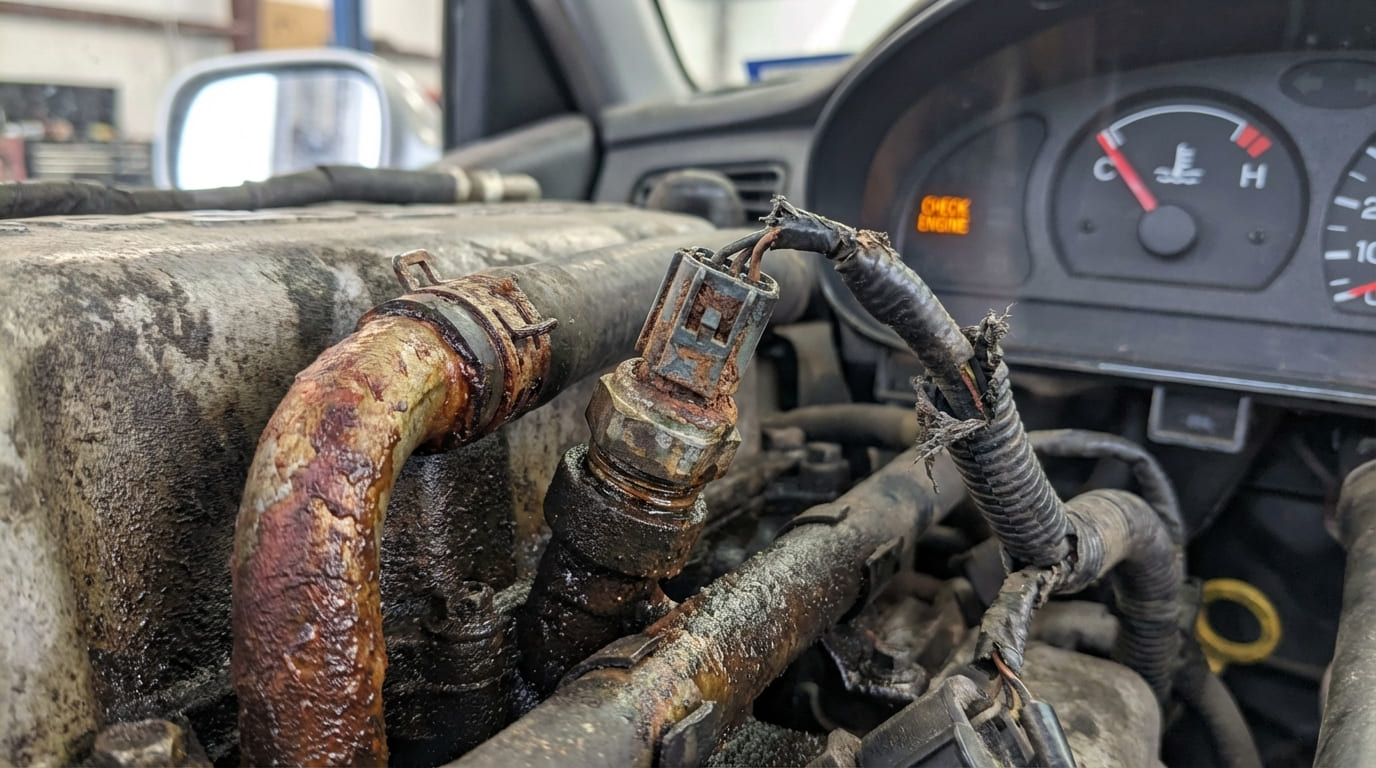
I’ve pulled dozens of “failed” sensors that were just coated in old coolant scale or sludge. Clean the bore before installing a new one. Use a thread chaser or tap to clean the threads—never force it in. Cross-threading ruins the coolant seal and kills thermal contact.
Symptoms of a Bad ECT Sensor
Don’t assume a rough idle or rich fuel mix means a bad ECT. Many issues overlap. But these signs point strongly to ECT trouble:
- Check Engine Light with codes P0115, P0116, P0117, or P0118
- Engine runs rich (smells like fuel, black tailpipe soot)
- Poor fuel economy
- High idle that won’t drop
- Fans run constantly—or never turn on
- Hard hot restarts or stalling
- Temp gauge stuck at cold or pegged hot
- Failed emissions test due to incomplete readiness monitors
How to Diagnose the ECT Sensor
Diagnosis should be systematic. Never replace the sensor on a hunch.
1. Use Live Data (OBD2 Scanner)
Start cold. Watch the ECT reading rise steadily. Compare it to an infrared thermometer on the thermostat housing or upper radiator hose. If the ECT says -40°C (open circuit) or 140°C+ (shorted), suspect a problem—but verify actual engine temp first.
2. Check Resistance (Sensor Disconnected)
Unplug the sensor. Use a multimeter to measure resistance. Heat the engine and retest. Resistance should drop smoothly as temp rises. If it reads “OL” (open) or doesn’t change, the sensor is likely bad. Always compare to factory specs—don’t trust generic charts.
3. Test Voltage (Backprobe Signal Wire)
With the key on, backprobe the signal wire. Voltage should be 3–4.5V when cold, dropping to 0.5–1.5V when hot. A steady 5V means an open circuit. A steady 0V means a short to ground. Check wiring and connectors before blaming the sensor.
4. Visual Inspection
Look for:
- Corroded or damaged connector
- Frayed or chafed wires (especially near exhaust)
- Scale or sludge on the sensor tip
- Coolant level and condition
Always bleed the cooling system after any coolant work. An air pocket around the ECT sensor will cause a false low reading. Run the engine with the radiator cap off (when cold!) to burp air. Top off as needed.
Repair vs. Replace: Cost and Viability
ECT sensors typically cost $20–$60. Labor is 0.5–1 hour if accessible. Total repair: $70–$150 at a shop. DIY replacement takes 20 minutes for most vehicles—just drain a little coolant, unplug, unscrew, and install the new one.
But replacement isn’t always the answer. Wiring issues, poor grounds, low coolant, or air pockets cause 30% of ECT-related faults. Replacing the sensor without checking these wastes time and money.
| Problem | Most Likely Fix | Cost Range |
|---|---|---|
| ECT reads -40°C | Check wiring, connector, coolant level | $0–$100 (if only reconnection or refill) |
| ECT reads 140°C+ | Inspect for shorted wire (e.g., against exhaust) | $50–$200 (repair harness vs. sensor) |
| Engine runs rich when warm | Test sensor resistance and live data | $20–$60 (sensor only) |
| Fans run constantly | Check signal voltage and fan relay | $50–$150 |
Real-World Diagnostic Lessons
A 2015 Ford F-150 came in with a P0118 (high input). The ECT read 140°C at startup. The owner replaced the thermostat and radiator. Then the sensor. Problem returned. I backprobed the signal wire and found it shorted to ground—chafed against the exhaust manifold. Fixed the wire, problem solved. The sensor was fine.
Lesson: Wiring damage in high-heat areas is common. Always test the harness.
A Honda Accord had high idle and ECT stuck at 40°C. Resistance test passed. I checked coolant level—low. Burped the system, refilled, and the ECT reading normalized. No parts replaced.
Lesson: Air pockets mimic sensor failure. Always verify coolant fill and bleeding.
A GM V6 had erratic ECT readings and fans kicking on randomly. No codes. Live data showed wild swings under load. Found a cracked cylinder head leaking coolant into a combustion chamber. The temperature changes were real.
Lesson: Erratic ECT data can reflect real engine problems—not a bad sensor.
The ECT sensor is a critical data source—but it’s not always the culprit. Treat its reading as information, not proof. Diagnose the circuit, verify coolant flow, and use live data over time. Replace only when testing confirms failure. And always consult your vehicle’s service manual: specs are not universal, and guessing can cost you.