In my experience, the water pump is one of the most overlooked components in the cooling system—until it fails. I’ve seen more than a few engines come into the shop with heat-related damage, and more often than not, the root cause traces back to a compromised pump that wasn’t moving coolant like it should. Let’s break down what the water pump actually does, how to diagnose failure, and what to do when it goes wrong.
Core Function: Circulating Coolant to Prevent Overheating
The water pump’s job is simple: move coolant through the engine block, cylinder head, and radiator to carry heat away. Without consistent flow, hot spots develop—especially around exhaust valves and combustion chambers—leading to warped heads, blown gaskets, or engine seizure. It doesn’t regulate temperature or pressure; it just keeps coolant moving.
How to Check if the Pump is Working
Don’t wait for overheating. Use these field-tested checks:
- Feel both radiator hoses after the engine reaches operating temperature. The top hose should be hot; the bottom hose should be warm. If the bottom hose stays cold, flow is restricted—could be the pump or thermostat.
- With the engine running and cold, remove the radiator cap (only when cool!) and look for steady coolant movement in the radiator neck. No flow? Pump or thermostat is suspect.
- Use an infrared thermometer to compare temperatures at the inlet and outlet of the engine. A difference of more than 10–15°F under load suggests poor circulation.
In my shop, we always perform a visual flow check before tearing anything down. It takes 60 seconds and rules out half the cooling issues.
Key Components and How They Fail
The pump’s reliability hinges on three parts: the impeller, shaft seal, and bearing. Failure in any one can kill the engine if ignored.
Impeller: The Heart of Flow
The impeller spins inside the pump housing, using centrifugal force to push coolant. Common failure modes:
- Corrosion or erosion—especially in aluminum or composite impellers exposed to wrong coolant types.
- Cracking or breaking from cavitation (air bubbles collapsing under pressure).
- Slipping on the shaft due to worn splines or adhesive failure.
How to check: Remove the thermostat and heater hoses, then spin the pump pulley by hand. Shine a flashlight into the outlet—you should see the impeller blades clearly. If blades are missing or eroded, replace the pump.
Shaft Seal and Weep Hole: Early Warning System
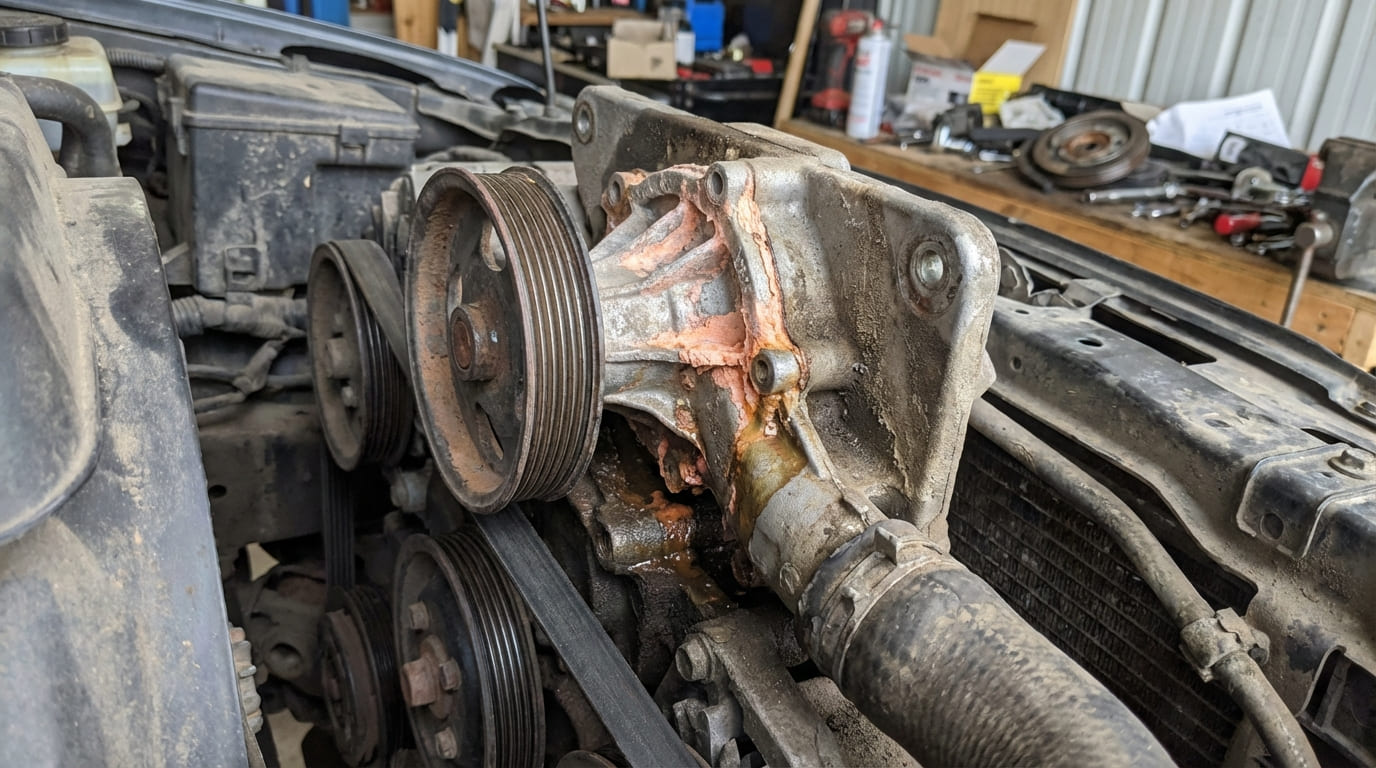
A mechanical seal keeps coolant from leaking into the bearing or engine. When it fails, coolant escapes through the weep hole—a small opening below the pulley.
- Dampness or drips at the weep hole mean seal failure. Replace the pump immediately.
- No visible leak but coolant loss? Inspect for internal seepage into the timing cover (common on timing belt-driven pumps).
If you see coolant weeping, don’t top off and drive. That seal is done. Continuing risks bearing failure and catastrophic timing belt damage.
Bearing: Silent Killer
The bearing supports the shaft. When worn, it causes noise or wobble that damages the seal.
- Listen for grinding, growling, or squealing from the front of the engine. RPM-dependent noise? Suspect the pump.
- Grab the pulley and wiggle it. Any lateral or vertical play means the bearing is shot.
Pump Drive Types: What You’re Dealing With
The drive method affects failure symptoms, labor cost, and whether you should replace it preventively.
| Drive Type | Symptoms of Failure | Replacement Cost (Labor + Part) | Replace Preventively? |
|---|---|---|---|
| Serpentine Belt Driven | Leak at weep hole, bearing noise, belt misalignment | $200–$400 | No, unless bearing is failing |
| Timing Belt Driven | Leak at timing cover, no noise, overheating | $600–$1,200 | Yes—replace with timing belt, especially over 80k miles |
| Electric (Primary or Auxiliary) | Overheating at idle, no pump noise, fault codes (sometimes none) | $400–$900 | Only if diagnosed faulty |
On timing belt-driven pumps, I always replace them at the same time as the belt. The labor is 90% the same. Paying $100 for a new pump now beats $1,000 for a tow and engine repair later.
Electric Water Pumps: Diagnose Differently
Electric pumps don’t rely on belts—they’re controlled by the ECU via PWM signals. Failures are often electrical, not mechanical.
- Check for power and ground at the connector with a multimeter.
- Monitor duty cycle with a scan tool if available. Should increase with engine temperature.
- Inspect connectors for corrosion—common on BMW, Audi, and GM turbo engines.
No flow but power present? The impeller may be broken or the motor burned out. Remove and inspect.
Common Cooling System Confusions
The pump is often blamed for issues it doesn’t cause. Know the difference:
- Thermostat regulates flow; if stuck closed, no coolant moves—even with a perfect pump.
- Radiator cap maintains pressure; a weak cap causes boil-over regardless of pump condition.
- Coolant hoses can collapse internally, starving the pump. Squeeze the lower hose under load—should stay firm.
Diagnostic Flow: What to Do When Overheating
Follow this sequence before replacing the pump:
- Check coolant level and condition. Low or rusty coolant? Flush and refill with correct type.
- Inspect for leaks—hoses, radiator, water pump weep hole, heater core.
- Verify fan operation—electric fans should turn on at ~220°F.
- Check for air pockets—burp the system with the radiator cap off and engine at operating temp.
- Perform a flow test: remove thermostat and observe flow at radiator neck while engine runs.
Test the thermostat: remove and place in hot water. Should start opening around 180–195°F.
If flow is weak and thermostat is out, the pump is likely failing.
Repair vs Replace: Cost and Longevity
Water pumps are rarely repaired—just replaced. Here’s what you need to know:
- OEM pumps cost $80–$200; aftermarket $40–$120. Don’t cheap out on timing-driven pumps—OEM is worth it.
- Always replace the thermostat when replacing the pump. Labor is already there, and thermostats often fail around the same time.
- Use the correct coolant. Mixing types can degrade seals and impellers—especially in aluminum or composite pumps.
I’ve seen cheap pumps fail in 15,000 miles. On critical applications—especially turbo or timing-driven—spend the extra $40 for OEM. Your engine will thank you.
Real-World Failure Scenarios and Lessons
Situation: A 2014 Subaru WRX came in with overheating under boost and a warped cylinder head. The shop assumed a head gasket failure.
Discovery: After teardown, the head was cracked near cylinder #3, but the gasket was intact. Coolant flow test showed only 40% of expected volume. The impeller—made of composite—had eroded blades due to chemical incompatibility with a silicate-free coolant that wasn’t OEM-specified.
Nuanced Lesson Learned: Coolant chemistry matters. Even if a product claims to be “universal,” it may not be compatible with specific impeller materials. Always verify against manufacturer specs.
Situation: A 2008 BMW 335i with electric water pump was overheating at idle, but fine at highway speeds.
Discovery: The pump wasn’t running at low RPM. Diagnostics showed no fault codes. Further testing revealed a failing PWM signal from the DME due to a corroded connector—intermittent and hard to catch.
Nuanced Lesson Learned: Electric pumps can fail electronically, not just mechanically. Voltage drop and signal integrity testing are as important as flow checks.
Situation: A 2010 Honda Accord had chronic overheating after a timing belt service. The shop replaced the thermostat twice.
Discovery: The new water pump had been installed with RTV instead of the specified dry gasket. Excess sealant had broken off and lodged in the coolant passage near the head.
Nuanced Lesson Learned: Deviating from OEM assembly procedures—even in small ways—can have major downstream effects. Follow the manual’s sealing method exactly.
Final Recommendations: Do This, Not That
- ✅ Do inspect the weep hole during oil changes. It takes 10 seconds and can save your engine.
- ✅ Do replace the pump preventively when doing timing belt service on interference engines.
- ✅ Do prime the cooling system after replacement—run the engine with the radiator cap off until all air is out.
- ⚠️ Don’t reuse old gaskets or apply extra sealant. Modern pumps are pre-sealed—follow the instructions.
- ⚠️ Don’t over-tighten bolts. Aluminum housings crack easily. Use a torque wrench.
- ⚠️ Don’t run the engine dry, even for a few seconds. The mechanical seal lubricates with coolant—dry spin kills it instantly.