As a master mechanic, I’ve seen countless vehicles come in with fuel pump issues—many misdiagnosed. The fuel pump’s job may sound simple, but its role is critical and often misunderstood. This guide cuts through the noise and gives you what you need: clear diagnostics, repair logic, and real-world insights to fix it right the first time.
Core Function: What the Fuel Pump Actually Does
The fuel pump has two non-negotiable jobs: deliver fuel from the tank to the engine and maintain precise fuel pressure. Without both, your engine won’t run properly—or at all.
It doesn’t matter if the vehicle has fuel injection or a carburetor; the pump must move fuel reliably under all conditions: cold starts, high load, and even when the tank is near empty. It also has to overcome fuel line resistance, elevation differences, and filter restrictions. Modern engines demand consistency—any drop in pressure or flow shows up as hesitation, stalling, or a no-start.
Fuel Delivery and Pressure Explained
Port fuel injection systems typically require 40–65 psi. Direct injection? That can exceed 2,000 psi. The pump must not only hit that pressure on startup but maintain it under load. If pressure fluctuates, the air/fuel mixture goes off balance, leading to misfires or poor performance.
The fuel pressure regulator manages the differential across the injectors, but the pump must support it. A weak pump can “idle fine” but fail under acceleration—this is why volume testing is just as important as pressure checks.
Fuel Pump Types and Locations: What You’re Dealing With
Knowing your pump type is the first step in diagnosis and repair. Here’s what you’ll encounter:
Electric Fuel Pumps (Most Common)
Found in nearly all modern vehicles. Two main types:
- In-tank (submersible): Mounted inside the fuel tank. Submersion cools the motor and reduces noise. Also less prone to vapor lock. Most common on fuel-injected cars from the last 25 years.
- In-line (external): Mounted along the frame rail. Seen in performance builds or high-demand trucks. Easier to access but exposed to heat and debris—requires shielding for longevity.
Mechanical Fuel Pumps (Classic & Carbureted Engines)
Driven by the camshaft via a pushrod or eccentric. Delivers 5–7 psi—perfect for carburetors but insufficient for fuel injection. Diaphragm design is simple but wears over time. Common failure points: cracked diaphragm, worn lever bushing, or broken linkage.
How the Fuel System Works Together
The fuel pump isn’t standalone. It’s part of a closed-loop system. Problems elsewhere can mimic pump failure—don’t overlook this.
Fuel Tank Module Components
In-tank pumps are part of a module that often includes:
- Fuel level sender
- Strainer (“sock filter”)—first defense against debris
- Fuel pressure regulator (on some models)
A clogged sock filter is a silent killer. It starves the pump, forcing it to work harder. I’ve replaced dozens of “failed” pumps only to find the real issue was a dirty tank or neglected sock filter.
Fuel Rail and Injectors
Fuel reaches the rail under pressure. The PCM signals injectors to open based on load, RPM, and sensor data. If pressure sags—even briefly—injectors can’t deliver the right amount of fuel. Result? Stumble, misfire, or lean codes.
How Fuel Pumps Actually Work
Understanding operation helps diagnose failure modes.
Electric Pump Operation
Most modern pumps use a turbine or impeller driven by a DC motor. Spinning creates centrifugal force to push fuel forward. Efficient and quiet, but sensitive to contamination and heat.
The check valve at the outlet maintains residual pressure after shutdown. If it fails, you’ll experience hard hot starts. No pressure in the line means the pump has to re-prime every time.
Mechanical Pump Operation
Camshaft motion drives a lever that flexes a diaphragm. Inlet and outlet check valves direct flow. Simple, but wear in the lever bushing or diaphragm fatigue leads to failure. If pressure drops under load, suspect mechanical wear or a kinked fuel line.
Modern Control Systems
Many electric pumps use a Fuel Pump Driver Module (FPDM) that adjusts speed via Pulse Width Modulation (PWM). The PCM monitors fuel trims and pressure sensors to manage demand.
A “low fuel pressure” code (like P0087) doesn’t always mean a bad pump. It could be a failing FPDM, bad sensor, or wiring issue. Always verify with a mechanical gauge.
How to Check: Diagnosing Fuel Pump Issues
Before pulling a tank or buying parts, follow this sequence. It saves time, money, and frustration.
Initial Checks (5-Minute Test)
Start simple:
- Check the fuel pump fuse and relay. Swap the relay with a known good one (like horn or A/C).
- Turn the key to ON (do not start). Listen for a 2-second hum from the tank. No noise? Could be pump, wiring, or FPDM.
- Inspect connectors—especially at the tank. Corrosion is common and kills the circuit.
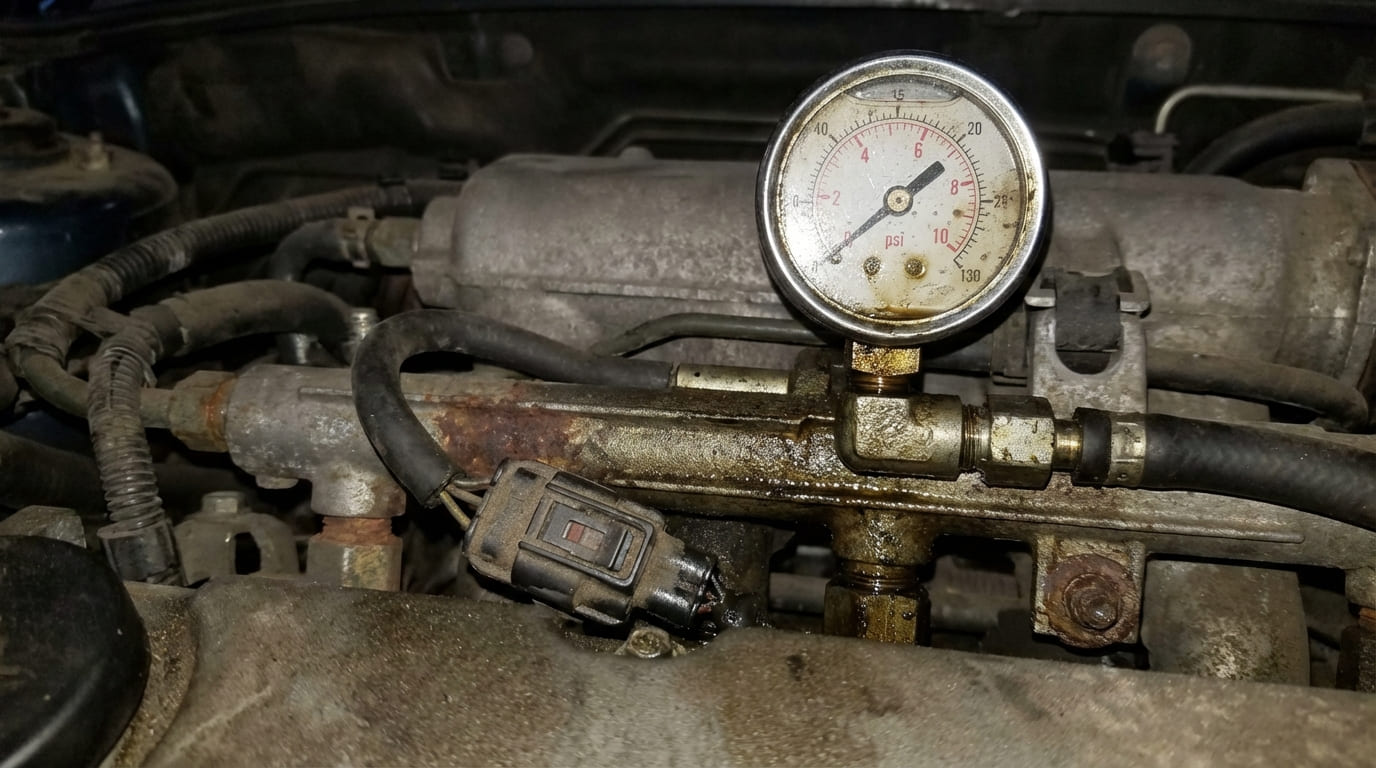
Fuel Pressure Test (Gold Standard)
Use a mechanical gauge on the fuel rail’s Schrader valve. Check three things:
- Key On, Engine Off (KOEO): Pressure should hit spec within 2–3 seconds.
- Running pressure: Must stay stable at idle and under load.
- Residual pressure: Should hold for at least 5 minutes after shutdown. Fast drop? Leaking check valve or regulator.
Typical specs: 50–65 psi for return-style systems. Direct injection: 500–2,500+ psi. Always consult your vehicle’s manual.
Fuel Volume Test (Don’t Skip This)
Pressure alone doesn’t tell the full story. A weak pump may make pressure at idle but fail under load.
Procedure:
- Relieve system pressure (remove fuel pump fuse, run engine to stall).
- Disconnect fuel line before the filter.
- Run pump for 30 seconds into a graduated container.
- Measure output.
Typical spec: 0.75 liters (750 ml) in 30 seconds. Low volume? Check sock filter, in-line filter, and pump efficiency.
Electrical Testing
Use a digital multimeter (DMM):
- Check for battery voltage (12.6V) at the pump connector with key ON.
- Test ground: Less than 0.1V drop means good ground.
- If voltage is low, trace back to FPDM, relay, or wiring.
- Motor resistance: If accessible, measure across terminals. Typical: 0.5–3 ohms. Out of range? Internal wear.
Scan Tool Data Analysis
Monitor live data:
- Fuel rail pressure sensor
- Fuel pump duty cycle
- Short Term Fuel Trim (STFT) and Long Term Fuel Trim (LTFT)
If STFT and LTFT are +15% or higher, the engine is adding fuel—could be a lean condition from low delivery. But cross-check with a mechanical gauge. Bad sensors can lie.
Costs and Repair vs Replace
Know what you’re up against before starting:
| Component | Part Cost | Labor Notes |
|---|---|---|
| Electric Fuel Pump (In-Tank) | $150–$400 | 4–6 hours labor (tank drop). OEM recommended. |
| Mechanical Fuel Pump | $40–$100 | 1–2 hours. DIY-friendly. |
| Fuel Pump Driver Module (FPDM) | $100–$250 | Often under vehicle. Check location first. |
| Fuel Pressure Gauge (Tool) | $50–$120 | Worth owning. Reusable for many diagnostics. |
Repair vs replace logic: If the pump is failing due to contamination, replacing it without cleaning the tank or changing the filter will lead to repeat failure. Always address root cause.
Common Failure Symptoms
Watch for these red flags:
- Engine cranks but won’t start: No fuel pressure. Check fuse, relay, and wiring first.
- Stalling under load: Could be weak pump, clogged filter, or low voltage.
- Hard starting when hot: Suggests leaking check valve or vapor lock.
- Loss of power or hesitation: Mimics ignition issues. Check fuel trims and pressure under load.
- Whining or buzzing from tank: Change in noise often means bearing wear or cavitation from low fuel.
- Check Engine Light with P0087: Low fuel pressure. Verify with mechanical gauge—sensor may be faulty.
Why Fuel Pumps Fail: Root Causes
Don’t replace a pump without asking “why did it fail?” Repeat failures are costly and avoidable.
Electrical Issues
Corroded connectors, bad grounds, blown fuses, or failing FPDM mimic pump failure. I’ve seen grounds corrode inside the tank harness—killing the circuit even with a good pump.
Contamination
Dirt, water, or rust in the tank clogs the sock filter or damages the impeller. Running the tank to “E” stirs up sediment. Always clean the tank if debris is present.
Overheating
In-tank pumps rely on fuel for cooling. Running low on fuel frequently causes overheating. Combine that with a clogged filter, and you’ve got a fast track to failure.
Mechanical Wear
Brushes and commutators wear out over time. High-mileage pumps may spin but lack pressure or flow. Resistance test helps confirm.
What to Do (and Not Do)
- ✅ Replace the sock filter and in-line filter when installing a new pump. Even if they look clean, they can restrict flow.
- ✅ Clean the fuel tank if debris is present. A few ounces of gunk can kill a new pump in weeks.
- ✅ Test fuel pressure and volume before condemning the pump. Electrical issues are common and cheaper to fix.
- ⚠️ Avoid replacing the pump without checking voltage and ground. Corroded connectors are a frequent culprit.
- ⚠️ Avoid running the tank low after installation. Keep it above 1/4 tank for the first 500 miles to protect the new pump.
- ⚠️ Avoid non-OEM or “high-flow” pumps unless your system is modified. Too much pressure can damage injectors or the regulator.
Real-World Diagnostic Scenarios
| Symptom | Most Likely Cause | Less Common But Possible Causes |
|---|---|---|
| No start, no pressure | Blown fuse, failed relay, or dead pump | Open circuit in harness, failed FPDM, or immobilizer lockout |
| Whining noise from tank | Worn pump bearings or cavitation from low fuel | Fuel slosh, loose module, or line resonance |
| Loss of power under load | Weak pump, clogged filter, or low voltage | Failing pressure regulator, restricted fuel rail, or PCM issue |
| Hard starting when hot | Leaking check valve or vapor lock | Failed regulator, leaking injectors, or poor tank venting |
Situation: A 2012 F-150 came in with a no-start. Pump replaced 6 months ago. No fuel pressure.
Initial Assumption: Another bad pump—common with cheap aftermarket units.
Deep Dive: Voltage at connector was only 9.2V. Found corroded ground splice near frame. Pump was fine.
Nuanced Lesson Learned: Recent replacement doesn’t mean it’s the problem. Electrical issues hide in plain sight.
Situation: Classic Mustang losing power at high RPM. Pressure dropped from 6 psi to 3.5 psi under load.
Initial Assumption: Worn diaphragm or weak spring.
Deep Dive: Replaced pump—issue returned. Found kinked fuel line near frame. Original pump was likely fine.
Nuanced Lesson Learned: Flow matters as much as pressure. Restrictions mimic pump failure under load.
Situation: 2018 Camry had P0087 and rough running. Scan tool showed 42 psi (needs 50 psi).
Initial Assumption: Failing pump or clogged filter.
Discovery: Mechanical gauge confirmed low pressure, but volume test was perfect. Fuel pressure sensor was reading 15% low. Replaced sensor—fixed.
Nuanced Lesson Learned: Never trust sensor data alone. Cross-verify with physical testing.
Fuel pump issues are rarely just about the pump. The system includes electrical, mechanical, and control components—all capable of failing in ways that mimic each other. Test methodically, verify assumptions, and fix the root cause, not just the symptom.