In my 20+ years turning wrenches in performance shops and diagnosing drivability issues, forced induction has always been a topic where theory meets real-world compromise. Superchargers, in particular, offer a compelling way to increase power without relying on exhaust energy like turbos do. But understanding how they work—and more importantly, how they behave under load—can save you hours of misdiagnosis and prevent costly mistakes.
Forced Induction Fundamentals
The core idea behind a supercharger is straightforward: force more air into the engine than atmospheric pressure alone would allow. This increases volumetric efficiency beyond 100%, meaning you’re packing more oxygen molecules into each cylinder. When combined with appropriate fueling, that translates directly into more power per combustion cycle.
Unlike turbochargers, which are driven by exhaust gas energy, superchargers are mechanically driven—typically by a belt connected to the crankshaft. That direct link means immediate response, but it also means the engine pays a parasitic horsepower cost to spin the unit. In my experience, this trade-off shapes everything from driveability to long-term reliability.
Types of Superchargers and How They Deliver Air
There are two broad categories: positive displacement and dynamic. Each behaves differently, and recognizing those differences helps you anticipate performance traits and potential failure points.
Positive Displacement Superchargers
These move a fixed volume of air per revolution, delivering strong low-end torque. The two main types are Roots and twin-screw (Lysholm).
Roots-Type Supercharger
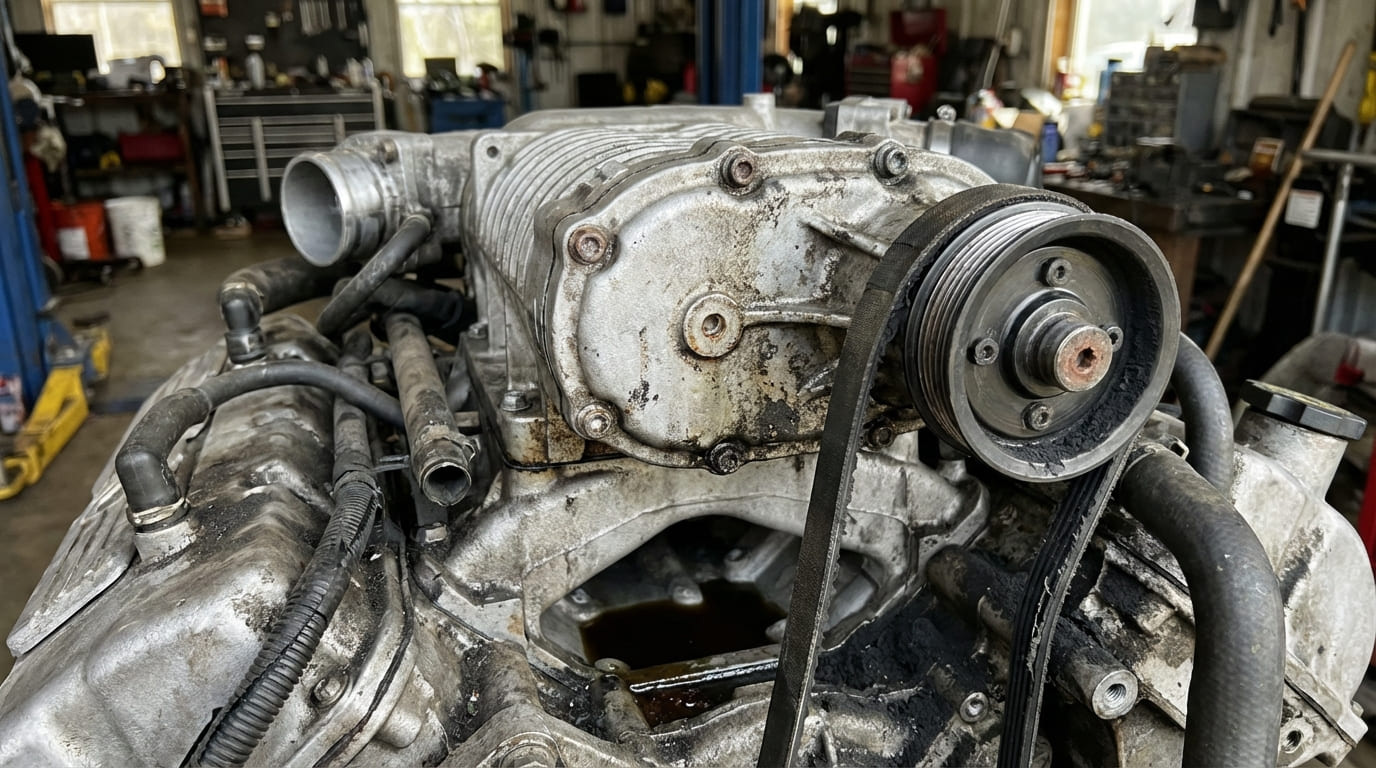
Common on street applications due to its simplicity and instant boost delivery. Two lobed rotors—usually three-lobe—rotate in opposite directions, trapping air at the intake and pushing it straight through the housing. Compression happens in the intake manifold, not inside the unit, which leads to higher charge temperatures.
How to check for issues: If you’re experiencing heat soak or detonation, verify intercooler function and ducting. Use an infrared thermometer to compare inlet and outlet temps. A difference of less than 50°F under load suggests poor cooling efficiency.
In my shop, we always inspect the rotor tips during disassembly. Scoring or wear indicates oil starvation or contamination—address the lube system before replacing the unit.
Twin-Screw (Lysholm) Supercharger
Uses helical rotors that compress air internally as it moves axially. This results in better thermal efficiency and smoother top-end power. However, rotor clearances are extremely tight—often under 0.002 inches.
How to check for issues: Listen for metallic scraping or grinding under load. Perform a borescope inspection through the intake ports if noise is present. Even minor housing warpage can cause rotor contact.
Never skip the break-in procedure on a rebuilt twin-screw. Run at light load for 30 minutes, then check oil for metal particles. A single shaving in the oil can mean catastrophic failure down the road.
Dynamic Superchargers: Centrifugal Type
Operates like a turbocharger but is belt-driven. An impeller spins over 100,000 RPM, accelerating air outward. A diffuser converts kinetic energy into pressure. Boost builds progressively with engine speed.
How to check for issues: If boost comes on too late or feels weak, verify pulley sizes and belt condition. Measure actual impeller speed with a strobe or laser tach if possible—slippage kills performance.
In my shop, we always upgrade to a high-grip cogged belt on centrifugal systems. The extra $30 prevents belt slip that can mimic a failing compressor.
Integration with Engine Systems
A supercharger affects multiple systems. Diagnose holistically—not just the blower.
Mechanical Drive System
All types are belt-driven from the crankshaft. Load varies: Roots units pull hardest at low RPM; centrifugal load increases with the square of speed.
How to check: Use a belt deflection gauge. Most manufacturers specify 1/2 inch of play at 10 lbs pressure. Misalignment? Use a laser alignment tool—visual checks miss up to 3 degrees of angular error.
Cost & viability: Replacing a belt costs $50–$150 in parts. Misalignment damage to bearings can cost $800+. Preventive alignment pays for itself.
Air Intake and Charge Cooling
Compression heats air—expect 100°F+ rise without intercooling. Air-to-air intercoolers are simpler; air-to-liquid offer consistent cooling in traffic.
How to check: Measure intake air temperature (IAT) before and after the intercooler. Under load, a functional system should reduce temps by 70–100°F. Less than that? Inspect for blocked airflow, collapsed hoses, or internal clogging.
Always seal the intercooler shroud. I’ve seen 30% efficiency loss from unsealed gaps. Use high-temp silicone and verify with a smoke test.
Lubrication Considerations
Positive displacement units use dedicated gear oil (e.g., 75W-90 synthetic). Change every 30,000–50,000 miles. Centrifugal units may be self-contained or engine-oil-fed.
How to check: For engine-fed units, verify oil pressure at the feed line with a tee fitting. No flow? Check for kinked lines or clogged filters. For self-contained units, drain and inspect oil—milky color means coolant ingress; metal flakes mean bearing wear.
Always pre-fill the supercharger oil before startup. Running dry for 10 seconds can destroy gears. I’ve seen it happen during first starts.
Diagnostic Decision Tree: Common Symptoms and What to Check
When performance drops, follow a systematic approach—don’t assume the supercharger is at fault.
- If boost is low: Check belt tension, pulley alignment, and boost leaks with a smoke test. Also verify bypass valve operation.
- If there’s whining or grinding: Confirm it’s not normal centrifugal whine. Then inspect bearings, drive gears, and mounting hardware.
- If detonation occurs: Review fuel trim, timing, octane, and charge temps. A lean condition can mimic mechanical issues.
- If oil is in the intake: Check supercharger seals, but also test for excessive crankcase pressure with a vacuum gauge.
Common Failure Scenarios and Root Causes
| Scenario | Most Likely Cause(s) | Less Obvious Possibilities |
|---|---|---|
| Loss of boost at high RPM | Belt slip, boost leak, wastegate malfunction (if equipped) | Intake restriction, collapsed intercooler hose, ECU fuel or timing rollback |
| Excessive heat in charge air | Failing intercooler, missing ducting, high ambient temps | Incorrect pulley ratio, poor compressor efficiency due to wear |
| Whining noise under acceleration | Normal operation (especially centrifugal) | Bearing wear, gear misalignment, resonance from loose mounts |
| Oil in intake tract | Worn supercharger seals | Crankcase ventilation issue, excessive crankcase pressure, overfilled oil |
Best Practices: Do and Don’t
- ✅ Recommended: Use a dial indicator to check rotor endplay during disassembly. Excessive movement usually indicates bearing wear.
- ✅ Recommended: Clean all oil passages thoroughly before installing a supercharger that uses engine oil. Even small debris can block flow and cause premature failure.
- ✅ Recommended: Torque mounting bolts in sequence and recheck after initial heat cycles. Aluminum housings expand differently than steel fasteners.
- ⚠️ Avoid: Reusing old belts when installing a new supercharger. Age and heat degrade rubber, increasing slip risk.
- ⚠️ Avoid: Ignoring belt deflection specs. Too tight increases bearing load; too loose causes slippage and inconsistent boost.
- ⚠️ Avoid: Assuming all supercharger oils are interchangeable. Some units require specific ISO grades or synthetic formulations.
Real-World Case Studies
Situation: A 2013 Shelby GT500 came in with inconsistent boost and occasional misfires above 5,000 RPM. Owner had recently upgraded the pulley for more boost.
Initial Assumption: We suspected the tune wasn’t matching the new pulley size.
Deep Dive: After reviewing logs, we noticed fuel trims were maxed out and timing was being pulled aggressively. But the MAF voltage looked normal. We pulled the intake and found the compressor wheel had slight blade damage—not from impact, but from ingested debris. The aftermarket air filter had a small tear.
Nuanced Lesson Learned: Even with perfect tuning, a small airflow disruption can destabilize the entire system. Always inspect the entire intake path—especially after modifications.
Situation: A 2004 Corvette with a roots-style supercharger was losing power gradually over several months. No check engine light.
Initial Assumption: Thought it was a slow boost leak or failing bypass valve.
Deep Dive: Boost pressure tested fine. But a borescope inspection revealed carbon buildup on the rotors. The oil separator was clogged, allowing crankcase vapors to coat the internals over time.
Nuanced Lesson Learned: Positive displacement superchargers are sensitive to oil contamination. Positive crankcase ventilation (PCV) system health directly impacts longevity—don’t overlook it during maintenance.
Situation: A custom-built Camaro with a centrifugal supercharger made great power but overheated under track use.
Initial Assumption: We focused on the engine cooling system—radiator, thermostat, water pump.
Discovery: The intercooler was mounted low in the front bumper, but the shroud wasn’t sealed. At speed, ram air bypassed the core. Also, the coolant in the air-to-liquid system wasn’t being circulated fast enough.
Nuanced Lesson Learned: Intercooling efficiency depends as much on system design as component quality. Thermal management is a system-wide challenge, not just a part swap.
One thing I’ve learned: real-world performance depends on integration. A supercharger doesn’t operate in isolation—it’s part of a network of systems that must work in harmony. Always consult the specific service manual for torque specs, oil types, and clearances. And when diagnosing, start broad. It’s tempting to blame the blower, but more often than not, the issue starts upstream or in the supporting systems.