As a master mechanic with two decades in diesel repair, I’ll cut straight to what matters: DPF issues are often misdiagnosed. Before you spend hundreds on cleaning or thousands on replacement, confirm the real problem. This guide covers only what you need—actionable diagnostics, repair steps, costs, and the hard-won tips that keep DPFs working long-term.
Diagnose Before You Clean or Replace
A warning light or limp mode doesn’t automatically mean a clogged DPF. Many technicians jump to cleaning or replacement without checking sensor inputs or upstream faults. That’s expensive guesswork. Start here.
Check for Common DTCs and Symptoms
Use a professional-grade scan tool (not a basic OBD2 reader) to pull codes and monitor live data. These are the most telling DPF-related trouble codes:
- P2002: DPF efficiency below threshold – often due to failed regeneration
- P242F: Ash accumulation restriction – indicates long-term oil or fuel contamination
- P244A: Differential pressure too low – could be sensor or hose issue
- P244B: Differential pressure too high – possible restriction, but verify cause
Accompanying symptoms include reduced power, poor fuel economy, excessive smoke after regen attempts, and engine oil dilution. If oil dilution exceeds 5%, suspect repeated failed regenerations—often from short-trip driving or mechanical faults.
Test the Differential Pressure System
The DPF’s differential pressure sensor (DPS) is critical—but often blamed incorrectly. Before condemning the DPF, verify the sensor and its hoses.
How to Check:
- Inspect both DPS hoses (upstream and downstream) for kinks, cracks, or soot blockage.
- Remove hoses and blow through them—replace if restricted.
- Use a scan tool to monitor DPF differential pressure (DPF_DP) at idle, 2000 RPM, and wide-open throttle.
| Condition | Typical DPF_DP Range (hPa) | Typical DPF_DP Range (PSI) | Diagnostic Clue |
|---|---|---|---|
| Idle | 0–5 hPa | 0–0.07 PSI | Zero or negative reading? Check for blocked, disconnected, or leaking hoses. |
| 2000 RPM | 10–30 hPa | 0.15–0.44 PSI | No change in pressure? Sensor may be faulty or clogged. |
| WOT | 100–300 hPa | 1.45–4.35 PSI | Excessively high? Confirm restriction—don’t assume DPF is clogged. |
In my shop, we always replace both DPS hoses as a pair. One collapsed hose can mimic a fully blocked DPF and lead to unnecessary cleaning or replacement.
Assess Soot Load and Ash Accumulation
Use your scan tool to read “Calculated Soot Mass” and “Measured Soot Mass.” If they differ by more than 5–10g, the system is miscalibrated or sensors are faulty.
Soot (carbon) can be burned off. Ash (from oil additives) cannot. Ash builds up permanently—typically 0.5–1g per 1,000 miles. After 100,000 miles, ash can occupy 30–50% of the DPF volume, especially if non-CJ-4/CK-4 oil was used.
How to Check: If differential pressure stays high after multiple regens and cleaning, ash is likely the culprit. No chemical or thermal cleaning removes fused metallic ash.
Rule Out Upstream Faults
Replacing a DPF without fixing the root cause is a waste. These issues overload the DPF with soot:
- Fuel injectors: Perform leak-off test and balance check. A leaking injector dumps fuel late in the cycle, increasing soot and risking DPF overheating.
- EGR system: Check for clogged cooler or stuck-open valve. High EGR flow increases soot production. Clean or replace as needed.
- Turbocharger: Test VGT operation and check for boost leaks. Poor airflow leads to incomplete combustion.
- Engine oil: Verify oil meets CJ-4, CK-4, or vehicle-specific low-ash specs. Conventional oil accelerates ash buildup.
I once traced a chronic DPF clog to cheap oil. The customer saved $10 on oil changes but spent $2,800 on a replacement DPF. Use the right oil—it’s cheaper in the long run.
DPF Cleaning Options: What Works and What Doesn’t
On-Vehicle Forced Regeneration
This burns off soot—not ash. It’s the first step if soot load is moderate and no mechanical faults exist.
Requirements:
- Fuel level above 1/4 tank
- Engine at operating temperature
- No active DTCs (e.g., EGT sensor faults)
- Professional scan tool with regen function
Procedure: Follow scan tool prompts. Some systems require stationary idle; others need road driving (e.g., 60 mph for 20 minutes). Monitor soot mass—it should drop to 0–5g.
Cost: $100–$250 at a shop. DIY with your own tool: $0 labor.
Warning: If soot load exceeds 40–45g, forced regen risks thermal runaway (temperatures >900°C), which can melt the substrate. Don’t attempt if soot mass is high.
Off-Vehicle Chemical Cleaning
Effective for stubborn soot and some light ash deposits. Not a DIY job—requires proper equipment.
Procedure:
- Remove DPF (labor-intensive—2–4 hours).
- Borescope to check for cracks, melting, or channel blockage.
- Soak in specialized solution (alkaline for soot, acidic for metallic deposits).
- Rinse with reverse-flow water to avoid pushing debris deeper.
- Dry completely—moisture causes thermal shock during regen.
Cost: $250–$500 at a professional shop.
Verification: Weigh the DPF before and after. A clean unit should lose 200–500g. Also test airflow on a flow bench—should return to 90%+ of spec.
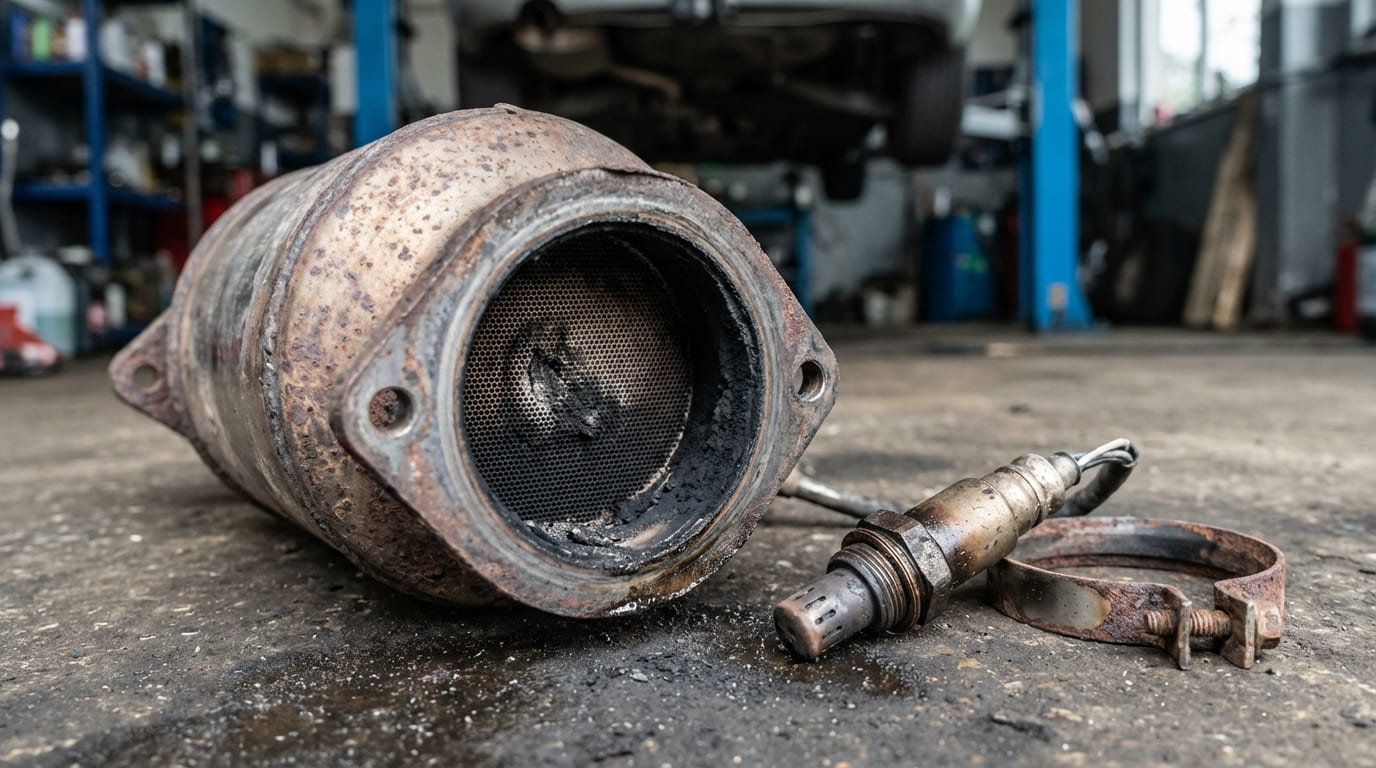
In my shop, we borescope every DPF before and after cleaning. If we see cracks or melting, we recommend replacement—no cleaning will fix structural damage.
Off-Vehicle Thermal Cleaning
Uses a kiln to burn off soot at 500–650°C. Effective for carbon, but risky for older units.
Procedure:
- Inspect for damage.
- Ramp temperature slowly over several hours.
- Soak, then cool gradually to prevent thermal shock.
- Use compressed air or vibration to remove loose ash.
Limitations: Thermal cycling can cause microfractures. Some units pass flow tests but fail within weeks. Not recommended for DPFs over 10 years old.
When to Replace the DPF
Cleaning won’t fix physical damage or severe ash blockage. Replace the DPF if:
- Borescope shows cracks, melting, or collapsed channels
- Ash accumulation persists after professional cleaning
- Back-pressure remains high post-cleaning
Once the honeycomb structure is damaged, flow dynamics are ruined. No amount of cleaning restores performance. Replace it.
OEM vs. Aftermarket DPF: Cost and Reliability
| Option | Pros | Cons | My Take |
|---|---|---|---|
| OEM DPF | Guaranteed fit, emissions compliant, includes sensors | $1,800–$3,500 | Best choice for longevity and compliance |
| Aftermarket (New) | $800–$1,500 | Inconsistent catalyst loading; may not regenerate properly | Test flow before installing. Some brands are reliable; others fail in 6 months. |
| Aftermarket (Reman) | $600–$1,000 | Unknown history; possible substrate fatigue | Only use if backed by warranty and flow test data |
DPF Removal and Installation
This is heavy, tight-work. One dropped DPF can damage exhaust components.
Procedure:
- Disconnect battery.
- Let exhaust cool completely.
- Label and remove DPS hoses, O2/NOx sensors.
- Support DPF with a jack—do not let exhaust hang.
- Unbolt flanges, replace gaskets and hardware.
- Torque to spec—over-tightening cracks cast flanges.
Inspect hangers and flex joints while the system is apart. A sagging exhaust stresses the DPF over time.
Post-Installation Steps
Skipping these steps causes false DTCs and failed regens.
- Clear all DPF-related codes.
- Perform DPF adaptation/reset via scan tool—resets soot and ash counters.
- Run a forced regeneration to verify function.
I’ve seen three comebacks in one month from shops that skipped the adaptation step. The ECU thought the new DPF was full. Always reset the system.
Verify the Repair
Scan Tool and Road Test
After service, monitor:
- DPF differential pressure—it should rise with load and return to baseline.
- Soot mass—it should build normally and burn off during regen.
Test drive through idle, cruise, and acceleration. Power should be restored. No limp mode should trigger.
Visual Inspection
Check for exhaust leaks at flanges and sensor ports. Even a small leak upstream of the DPS skews readings. Ensure all hoses and sensors are secure.
Long-Term Maintenance
To extend DPF life:
- Use only low-ash oil (CK-4, CJ-4, or manufacturer-specified)
- Avoid frequent short trips—passive regeneration needs sustained heat
- Keep DEF tank filled (if equipped)
- Address engine faults immediately—injectors, EGR, turbo
Situation: 2015 Ram 2500 with P244B and high DPF_DP. Customer tried two forced regens. I checked DPS hoses—found one collapsed internally. Replaced both hoses, recalibrated sensor. DPF_DP normalized. No cleaning or replacement needed.
Nuanced Lesson: High differential pressure doesn’t always mean a dirty DPF. Always check hoses and sensors first.
Situation: SUV with recurring P2002 after DPF cleaning. Owner used conventional oil. Lab test showed high calcium and zinc—additives from wrong oil. Switched to CK-4, problem stopped.
Nuanced Lesson: Cleaning is temporary if oil spec isn’t enforced. The DPF records your maintenance habits.
Situation: Delivery van with failed regens. EGTs spiked too fast. Found leaking injector—fuel igniting in exhaust. Fixed injector, regens completed normally.
Nuanced Lesson: DPF overheating isn’t always from soot. Unburned fuel from injector issues can be just as destructive.
Best Practices: Do This, Avoid That
- ✅ Verify DPS hose condition and sensor calibration before diagnosing DPF restriction.
- ✅ Perform full engine health check (injectors, EGR, turbo) before DPF service.
- ✅ Use OEM-spec low-ash oil—CK-4, CJ-4, or equivalent.
- ⚠️ Avoid skipping DPF adaptation after replacement—ECU must reset counters.
- ⚠️ Avoid generic scan tools for forced regen—they lack safety monitoring.
- ⚠️ Avoid reusing old gaskets or hardware—thermal cycling weakens them.
Remember: The DPF is a symptom recorder, not usually the root cause. Cleaning or replacement can restore function, but long-term success depends on fixing why it clogged in the first place. Always consult the vehicle-specific service manual for exact procedures, thresholds, and reset protocols—what works on one diesel won’t work on another.