Over two decades in the shop, I’ve seen hybrid diagnostics evolve from guesswork to precision. The biggest mistake? Assuming the high-voltage (HV) battery is dead when the real issue lies in the engine or control systems. This guide cuts through the noise, focusing on actionable diagnostics, real-world symptoms, and cost-effective decisions. We’ll help you isolate whether the problem is in the internal combustion engine (ICE), the HV battery, or a shared system like the DC-DC converter.
Start with the Right Tools and Data
A capable OEM-level scan tool is essential. Generic OBD2 scanners often miss HV system codes or misrepresent live data. Without access to cell voltages, SOC trends, and inverter status, you’re working blind. Invest in a professional tool or use a shop with OEM access—this single step prevents misdiagnosis 80% of the time.
Retrieve and Interpret Diagnostic Trouble Codes (DTCs)
DTCs are your roadmap, but they require context. Don’t replace parts based on codes alone—verify with live data.
- P0Axx, P3xxx, B1xxx, C1xxx: Point to HV system faults—battery, inverter, motor-generators, or control modules.
- P01xx–P05xx: Typically engine-related—fuel, ignition, airflow, emissions.
- Uxxxx (Communication DTCs): Often misleading. Can stem from a failing DC-DC converter, weak 12V battery, or loose HV connections.
Always check freeze frame data: Was the HV battery low? Was the engine under load? A code triggered during cold start may be irrelevant if it doesn’t repeat.
Monitor Critical Live Data Parameters
Live data reveals what static codes can’t. Drive the vehicle under real conditions and watch:
- HV Battery State of Charge (SOC)
- Individual cell block voltages
- Inverter temperatures and current flow
- Motor-Generator (MG) RPM and current
- Engine RPM, fuel trims, misfire counters
- 12V system voltage (output from DC-DC converter)
For example, if the engine runs rough only when SOC drops below 40%, suspect engine fuel or ignition issues—not the battery.
How to Check: Differentiate HV Battery vs. Engine Issues
Use symptoms and data together. Many problems overlap, but the right tests isolate the root cause.
Symptoms Pointing to HV Battery or Related Systems
If the vehicle won’t start in EV mode, loses EV range rapidly, or triggers a “Check Hybrid System” light, focus on the HV side.
How to Check:
- Scan for P0Axx or P3xxx codes.
- Monitor cell block voltages under load. A spread >0.25V suggests imbalance.
- Check battery temperature differentials—>5°C between blocks indicates cooling issues.
- Verify DC-DC output: Should be steady 13.5–14.5V. Dips below 12V destabilize engine controls.
If cell voltages collapse under acceleration or SOC drops abnormally fast, the battery is degrading. But don’t replace it yet—confirm cooling and connections.
Symptoms Pointing to Engine (ICE) Problems
Rough idle, misfires under load, black/white exhaust smoke, or poor fuel economy with normal HV data point to the engine.
How to Check:
- Inspect spark plugs for fouling, gap wear, or oil deposits.
- Test fuel pressure and volume—many pumps fail under load despite good idle pressure.
- Swap ignition coils between cylinders to see if misfires follow.
- Monitor fuel trims. Long-term trims >+10% indicate lean condition; <-10% suggest rich.
If engine issues only occur when the HV battery is low, the engine may be compensating for reduced assist—fix the battery first.
Ambiguous Symptoms: When It’s Not Clear
Limp mode, intermittent power loss, or U codes can originate from either system.
How to Check:
- Monitor 12V voltage during fault occurrence. A drop below 10V often points to DC-DC converter failure.
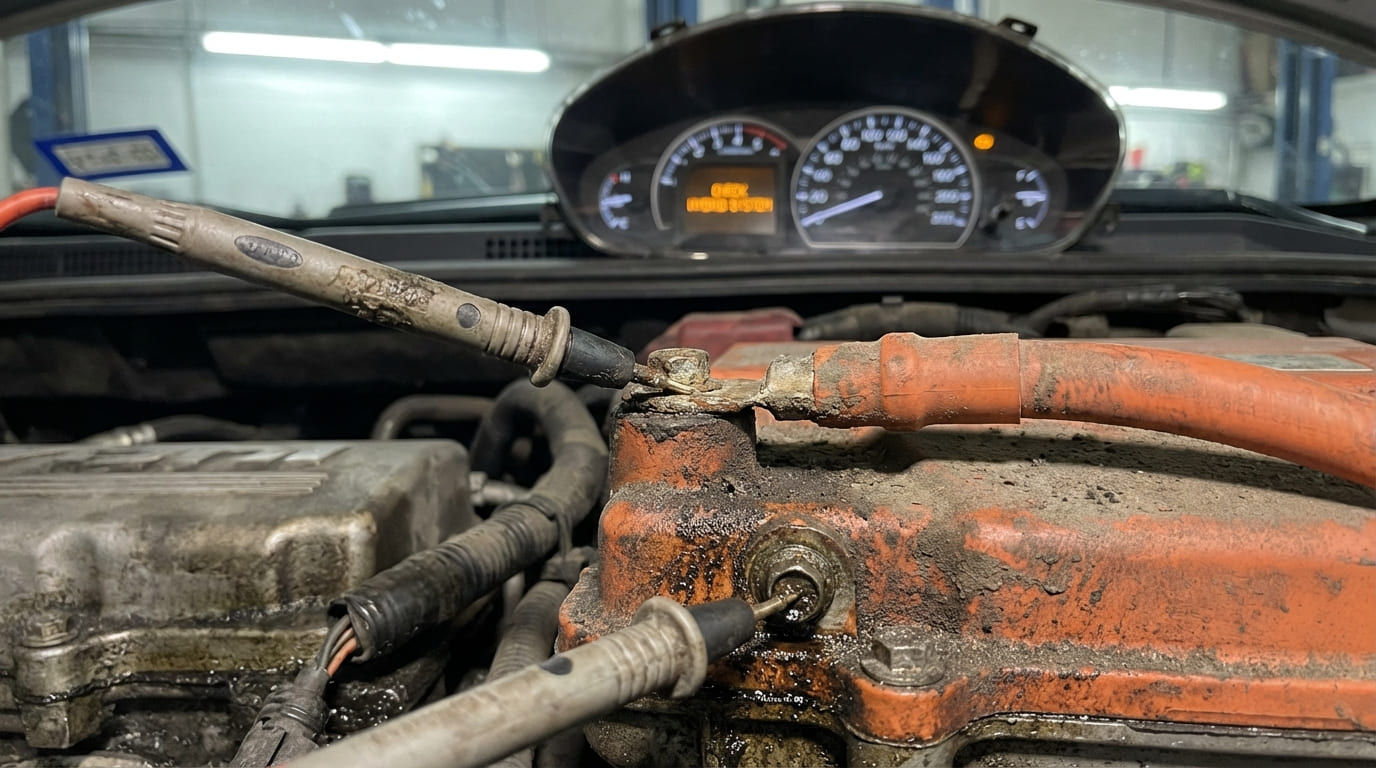
- Check for loose HV connectors or corroded terminals—common in high-mileage hybrids.
- Review communication DTCs: Are multiple modules dropping offline? Likely power or grounding issue.
Never assume. A failing DC-DC converter can mimic engine stalling by starving the ECU.
HV Battery Diagnosis: Beyond the Obvious
The HV battery is expensive to replace—don’t condemn it without thorough testing.
Live Data Analysis
Cell imbalance is the earliest sign of battery trouble. Under load or charge:
- Cell block voltage deviation >0.25V is a red flag.
- Rising internal resistance reduces power delivery—compare to baseline if available.
- Temperature differences >5°C between blocks suggest cooling failure or cell degradation.
In my shop, we always record cell voltages on high-mileage hybrids during routine visits. Trends matter more than single readings. A block drifting down over months confirms degradation.
HV Battery Cooling System Inspection
Overheating causes premature aging. Check:
- Cooling fan operation (listen during high SOC charging).
- Air ducts for blockages (leaves, debris).
- Coolant level and pump function in liquid-cooled systems.
A blocked duct or failed fan can trigger thermal throttling—often mistaken for low capacity.
Physical Inspection (After HV Deactivation)
Only proceed after removing the HV service plug and verifying zero voltage.
- Look for corrosion on terminals—clean with a dielectric-safe brush.
- Check for case swelling or electrolyte leakage.
- Inspect connections for looseness or oxidation.
Re-tighten terminals to spec—many issues stem from poor contact resistance.
Repair vs. Replace: Cost and Viability
Full HV battery replacement costs $1,500–$4,000. Reconditioning (cell replacement and balancing) costs $800–$1,800 and often restores 80–90% capacity.
DIY cell replacement is possible but risky—requires precision welding and HV safety training. Not recommended for beginners.
Inverter and Motor-Generator Checks
The inverter and MGs are less common failure points but can mimic battery or engine issues.
Inverter Diagnosis
Codes like P0A78 (overheating) or P0A80 (DC-DC failure) are strong indicators.
How to Check:
- Monitor inverter temperature—spikes >85°C under load suggest cooling issues.
- Check DC-DC output stability—fluctuations destabilize engine controls.
- Inspect for discolored heatsinks, coolant leaks, or burnt components.
Most inverter failures require full replacement—$1,200–$2,500. No practical DIY repair.
Motor-Generator (MG) Testing
MGs rarely fail, but contamination or bearing wear can occur.
How to Check:
- Watch for erratic MG RPM in EV mode.
- Check for excessive current draw or failed regen braking.
- Test winding resistance (phase-to-phase) and insulation (phase-to-ground).
Resistance should be <1 ohm (per OEM spec). Insulation <1 MΩ indicates moisture or damage.
MG replacement is complex—typically $2,000+ and requires transaxle removal.
Engine System Diagnosis: Don’t Overlook the Basics
Even in hybrids, engine health is critical. Poor performance often traces back to fuel or ignition.
Fuel System Testing
How to Check:
- Test fuel pressure (40–60 psi typical) and volume (250–300 ml/min over 30 sec).
- Check residual pressure—should hold within 5 psi for 10–15 minutes.
- Use scan tool to monitor fuel trims and injector pulse width.
Fuel filter replacement is DIY-friendly. Pump or rail replacement often requires professional tools.
Ignition System Testing
How to Check:
- Inspect all spark plugs—look for wear, fouling, or oil deposits.
- Swap coils to confirm misfire follows.
- Use secondary ignition pattern on scope to detect weak coils.
Replace all plugs and coils as a set on high-mileage hybrids—stop-start cycling increases wear.
Diagnostic Decision Table
| Symptom | Possible Causes (Likelihood) | Recommended Next Step |
|---|---|---|
| Vehicle won’t start, no engine crank | 12V battery (high), DC-DC converter (moderate), HV battery (low unless 12V is dead) | Check 12V voltage and DC-DC output first |
| Engine runs rough only when HV battery is low | Engine fuel/ignition (high), vacuum leaks (moderate), MAF sensor (moderate) | Monitor fuel trims and misfire counters under load |
| EV mode unavailable, HV warning light | HV battery cell imbalance (high), cooling fault (moderate), inverter issue (low) | Scan for P0Axx codes, check cell voltages and temps |
| Poor fuel economy despite normal engine operation | Driving habits (high), HV battery degradation (moderate), regen braking fault (low) | Review HV battery SOC retention and regen current in live data |
| Intermittent power loss, U codes present | DC-DC converter (high), 12V system load (moderate), loose HV connections (low) | Monitor 12V voltage during fault occurrence |
Best Practices: Do and Avoid
- ✅ Recommended: Use OEM scan tools for HV system diagnostics. Aftermarket tools may not access all modules or cell-level data.
- ✅ Recommended: Clean HV battery terminal threads with a tap before reassembly. Corrosion increases resistance and causes communication errors.
- ✅ Recommended: Record baseline cell voltages and resistance values on high-mileage hybrids. Trends matter more than single readings.
- ⚠️ Avoid: Assuming HV battery failure based on “reduced EV range” alone. Driving habits, climate, and terrain heavily influence range.
- ⚠️ Avoid: Reusing HV system fasteners unless specified. Many are torque-to-yield and lose clamping force when reused.
- ⚠️ Avoid: Skipping 12V system checks. A weak auxiliary battery can cause communication failures that mimic HV faults.
Situation: A 2012 Toyota Prius came in with “check hybrid system” and no EV mode. The owner was told the battery needed $2,500 replacement.
Initial Assumption: HV battery degradation—common at this mileage.
Deep Dive: I pulled P0A80 (DC-DC converter malfunction). Live data showed 12V voltage dropping to 9.8V during acceleration. The HV battery SOC and cell balance were normal.
Nuanced Lesson Learned: Don’t assume HV battery failure without ruling out power delivery to control systems. The DC-DC converter was faulty, starving the ECU and forcing the system into failsafe. Replaced the converter—fixed for $600.
Situation: A Honda Insight struggled to start, then ran rough. Scan tool showed P0300 (random misfire) and low fuel trims.
Initial Assumption: Ignition or fuel issue—common in older engines.
Deep Dive: Plugs and coils were new. Fuel pressure was good. But live data showed HV battery SOC dropping rapidly during cranking. Further testing revealed a failing HV relay that intermittently cut power to the starter motor.
Nuanced Lesson Learned: Even engine-specific codes can have HV system roots. Always cross-check HV stability during engine events.
Situation: A 2015 Ford Fusion Hybrid had poor acceleration. No DTCs. Tech replaced throttle body and cleaned injectors—no change.
Initial Assumption: Mechanical or fuel delivery issue.
Deep Dive: HV data showed one cell block consistently 0.35V lower than others under load. The battery management system was limiting power to prevent damage.
Nuanced Lesson Learned: Absence of DTCs doesn’t mean the HV system is healthy. Sub-threshold cell imbalances can still trigger power limiting. Always check cell voltages under dynamic conditions.
In my shop, we treat hybrid diagnostics like a detective story—every clue matters, and the obvious suspect isn’t always guilty. The interplay between HV and ICE systems demands patience and layered testing. Always consult the specific OEM service manual for tolerances, procedures, and data thresholds—what’s normal for a Prius isn’t the same for a Volt or an RX Hybrid.