In my experience across two decades of shop work, few maintenance oversights seem as minor yet carry such hidden risk as mixing coolant types. It’s not uncommon to see a DIYer top off a pink OAT coolant with green IAT because “it’s all just antifreeze,” only to return months later with overheating issues or a failed water pump. While some modern coolants are marketed as “universal” or “compatible,” the chemistry underneath is far more sensitive. What follows is a breakdown of what actually occurs when these formulations clash, how to spot the damage, and what to do about it—no theory, just what matters for your engine.
What Actually Goes Wrong When Coolants Mix
Mixing coolant types doesn’t just dilute performance—it triggers chemical reactions that degrade protection and create damaging byproducts. The main issue isn’t the glycol base, but the additive packages designed to protect metals, control pH, and prevent corrosion. When incompatible inhibitors interact, they can precipitate, gel, or become corrosive.
Key Reactions and Their Effects
- Silicate dropout: Common when IAT (green) coolant mixes with OAT (orange/pink). Silicates fall out of solution, forming abrasive gel that clogs radiators and damages water pumps.
- Phosphate scaling: Found in older IAT and some HOAT coolants. Reacts with minerals or other inhibitors to form chalky deposits in heater cores and radiator tubes.
- Carboxylate polymerization: OAT coolants can form sticky residues when pH shifts, coating thermostats and pump impellers, reducing flow.
- Borate breakdown: In IAT/HOAT, borates stabilize pH. When disrupted, they form boric acid, which attacks aluminum components at high temps.
- pH crash: Buffers neutralize when mixed, dropping pH below 7.5. Acidic coolant eats copper, brass, and aluminum—coolant at pH 5.8 is like weak vinegar in your engine.
- Foaming and cavitation: Surfactants fail, allowing air in the system. This leads to cavitation erosion on diesel cylinder liners and pump impellers.
In my shop, we always assume mixed coolant when we see sludge, even if the customer insists they “only used the right color.” Color is meaningless. Always verify the exact type by checking the bottle or service record.
Real-World Incompatibility Scenarios
| Mix Scenario | Typical Reaction | Observed Consequences | Relative Risk Level |
|---|---|---|---|
| IAT + OAT | Silicate dropout, carboxylate degradation | Rapid sludge formation, radiator blockage, accelerated corrosion | High |
| IAT + HOAT | Inhibitor cross-reactivity, possible silicate precipitation | Moderate sludge, reduced service life, heater core restriction | Moderate |
| OAT + HOAT | Dilution of HOAT-specific additives (e.g., nitrites) | Reduced cavitation protection, shortened service interval | Low to Moderate (diesel applications higher risk) |
| Propylene Glycol + Ethylene Glycol | Altered viscosity and heat transfer | Unpredictable freeze/boil performance, reduced pump efficiency | Low (but not zero) |
How to Diagnose Coolant Mixing
Don’t guess—test. These steps will confirm if mixing has occurred and how severe the damage might be.
1. Visual Inspection
Check the coolant in both the reservoir and radiator (when cold). Look for:
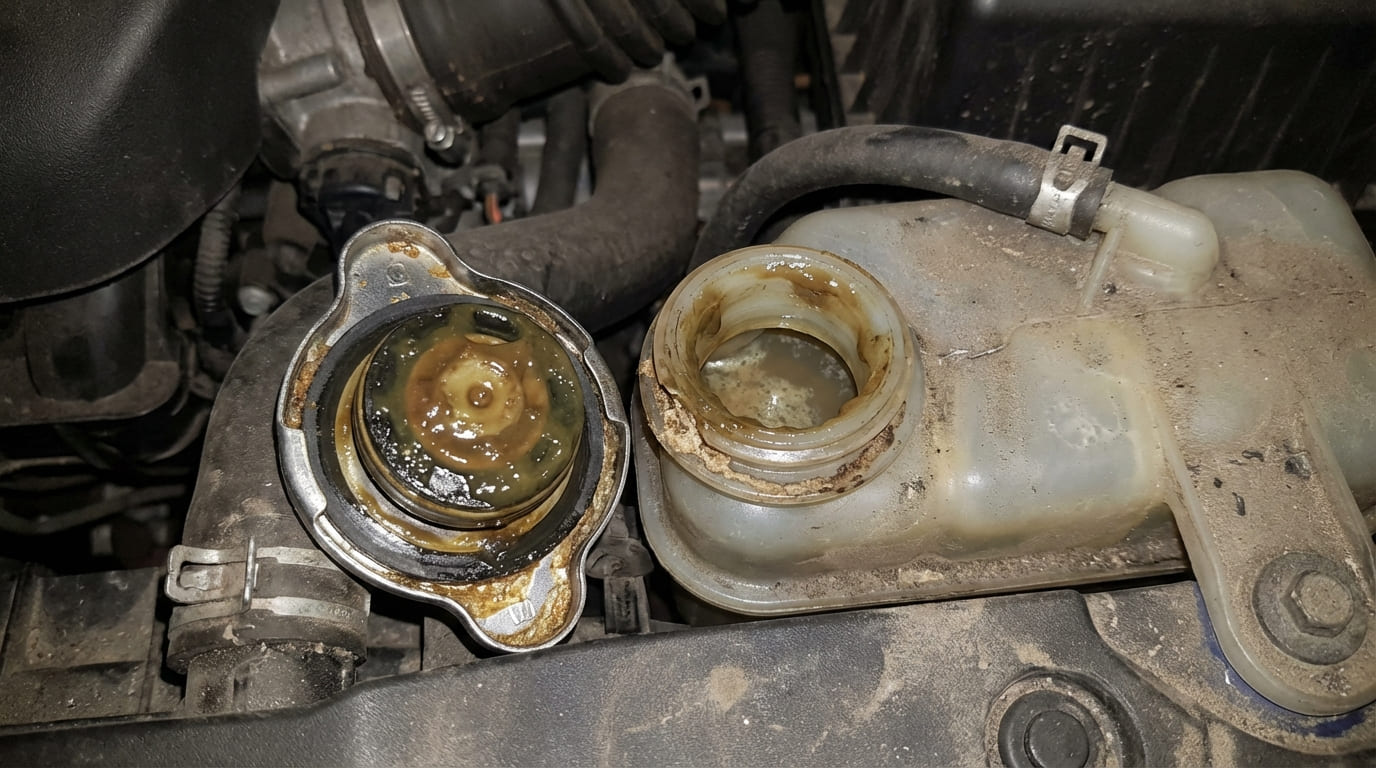
- Brown, murky, or oily appearance
- Visible particles, gel, or floating film
- Discoloration inconsistent with OEM spec (e.g., milky pink in a green-coolant vehicle)
Remove a radiator hose and inspect the inside—gel buildup often hides there.
2. pH and Concentration Testing
Use a digital pH meter (under $30) to test coolant directly. Acceptable range: 8.0–10.5. Below 7.5 = acidic and corrosive.
Use a refractometer to check concentration. A 50/50 mix is standard. Over-dilution worsens chemical instability.
Test strips can help detect low nitrite levels—critical for diesel engines using HOAT.
3. Performance Checks
Monitor for:
- Overheating or fluctuating temps (OBD2 scan tool recommended)
- Weak heater output despite normal engine temp
- Water pump noise or leaks
Use an infrared thermometer on heater hoses—both should read within 10°F of each other when hot. A cool return hose means blockage.
Situation: A 2010 Honda Civic came in with intermittent overheating. Coolant was orange, looked clean, but the customer admitted topping off with “whatever was on sale.”
Discovery: After flushing, we found a thick, translucent gel in the radiator outlet hose. Lab analysis showed a mix of OAT and IAT coolants. The thermostat was gummed up, not faulty.
Nuanced Lesson Learned: Not all sludge is visible at the filler neck. Even “compatible” colors can hide incompatibility. Always verify the exact coolant type, not just the hue.
Situation: A diesel pickup had repeated water pump failures. Each time, the impeller showed erosion, but the coolant looked fine.
Discovery: The owner had been mixing a nitrite-free OAT with a nitrite-rich HOAT, diluting cavitation protection. The foaming wasn’t visible, but the damage was cumulative.
Nuanced Lesson Learned: Cavitation damage can occur without obvious visual cues. In diesel engines, maintaining nitrite levels is critical—don’t assume all extended-life coolants are interchangeable.
How to Fix a Mixed Coolant System
Once mixing is confirmed, the only reliable fix is a complete system overhaul. Here’s what to do—and what to avoid.
Corrective Steps
- ✅ Drain and flush thoroughly: Use distilled water, run engine to operating temp 2–3 times. Drain each time. Repeat until outflow is clear and pH-neutral.
- ✅ Replace thermostat: Sludge gums up wax pellets. Replacement costs $15–$40 and prevents comebacks.
- ✅ Inspect water pump: Look for seal wear, bearing play, or impeller pitting. Replace if any doubt—$100–$300 part, but cheaper than a tow.
- ✅ Back-flush heater core: Use reverse water pressure. Brown sludge here kills heat output.
- ✅ Refill with OEM-specified coolant: Use pre-mixed 50/50 if unsure. Cost: $15–$30 per gallon. Never guess based on color.
What to Avoid
- ⚠️ Don’t reuse old coolant: Once inhibitors react, they’re gone. No additive can restore protection.
- ⚠️ Don’t use chemical flushes routinely: Harsh cleaners can damage seals. Use only for confirmed sludge, and rinse *extensively*.
- ⚠️ Don’t top off with “universal” coolant: There’s no true universal. “Compatible” often means “less incompatible”—still risky.
After refill, test freeze point with a refractometer. Monitor coolant every 500 miles for discoloration or pH drop. Retest at 1,000 miles.
In my shop, we’ve learned the hard way that coolant compatibility isn’t just about chemistry—it’s about discipline. The savings from using whatever’s on hand rarely outweigh the cost of a replaced radiator ($300–$800) or head gasket ($1,000+). Always refer to the vehicle manufacturer’s specification. It’s not arbitrary—it’s based on real-world testing.