Catalytic converter problems are frequently misdiagnosed. Codes like P0420 and P0430 often point to the converter, but the real issue may stem from engine performance or sensor faults. Replacing a catalytic converter can cost $500 to $2,500 depending on the vehicle—so accurate diagnosis is critical. This guide delivers proven, non-invasive tests to determine if your converter is truly failing, using tools most DIYers and shops already own.
Step 1: Assess Symptoms and Rule Out Root Causes
Before testing the converter, confirm the engine is functioning properly. A failing converter is usually a symptom, not the source. Address these first:
Key Symptoms and What They Suggest
- Loss of power or poor acceleration: Could indicate exhaust restriction, but also consider fuel pump, ignition, or turbo issues.
- Engine hesitation or stalling: Often caused by rich fuel mixtures from bad injectors or O2 sensors—both of which can damage the converter over time.
- Rotten egg smell: Sulfur odor usually means the converter isn’t processing sulfides—common with low-quality fuel or rich running conditions.
- Excessive undercarriage heat or red-hot exhaust: Indicates unburned fuel entering the exhaust, typically from misfires.
- Rattling noise from the converter: A clear sign of internal substrate collapse. Replacement is required—but find out why it failed first.
Diagnostic trouble codes are clues, not verdicts:
- P0420 / P0430: Catalyst efficiency below threshold. Common, but often triggered by upstream issues like exhaust leaks or faulty O2 sensors.
- P0133: Slow upstream O2 sensor response can mimic converter inefficiency.
- P0171/P0174 (lean) or P0172/P0175 (rich): Fuel trim problems can trick the system into thinking the converter is bad.
In my shop, we never replace a catalytic converter without first ruling out engine issues. I’ve saved customers hundreds by fixing a $20 vacuum leak instead of a $1,200 cat.
Pre-Test Requirements
Testing is only valid if these conditions are met:
- Engine at full operating temperature (coolant gauge in normal range).
- No active misfires (check via OBD2 scanner).
- Upstream O2 sensors responding correctly (use live data or scope).
- No exhaust leaks upstream of the converter or near the downstream O2 sensor.
Step 2: Perform Non-Invasive Diagnostic Tests
Exhaust Backpressure Test (Check for Clogging)
This test detects physical blockage in the exhaust system, often caused by a melted or collapsed catalytic converter substrate.
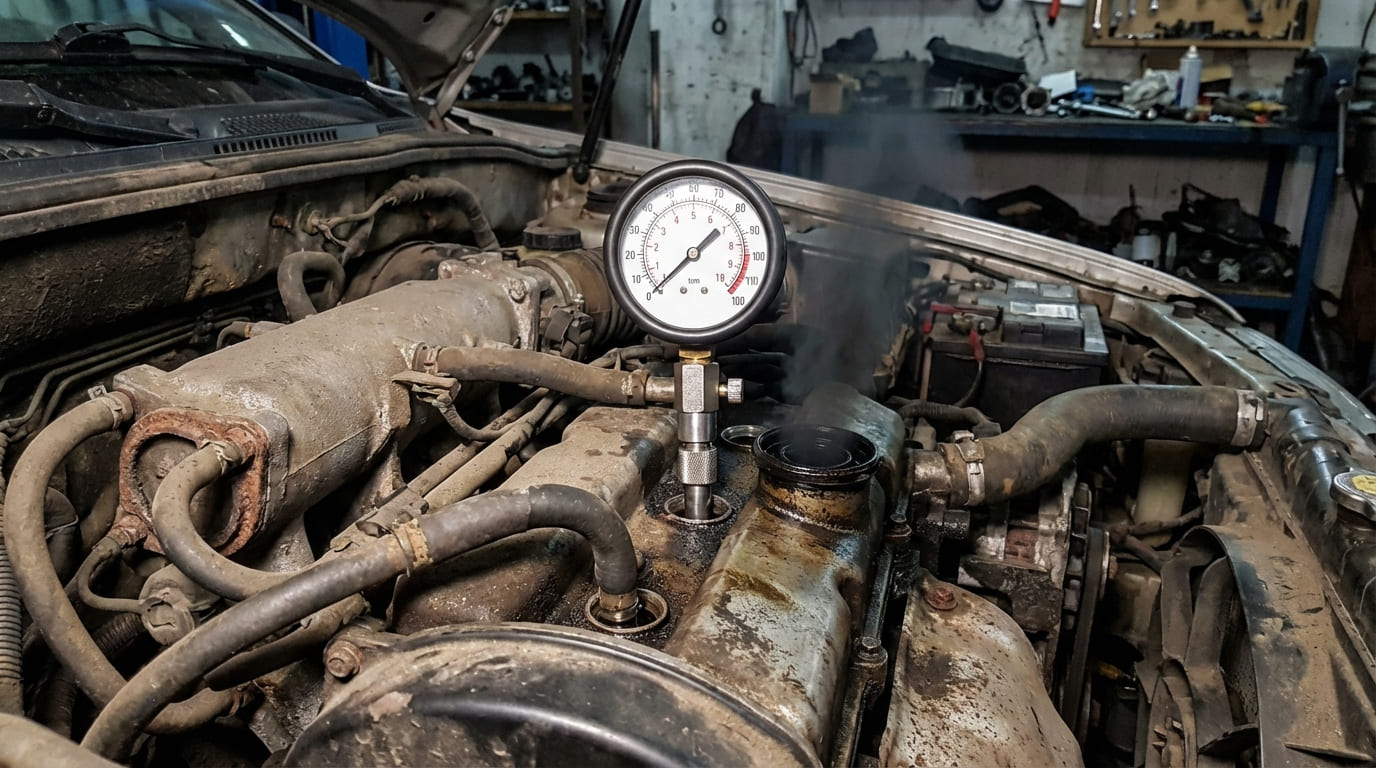
Tools needed: Exhaust backpressure gauge (0–15 PSI range), O2 sensor socket, wrench.
Procedure:
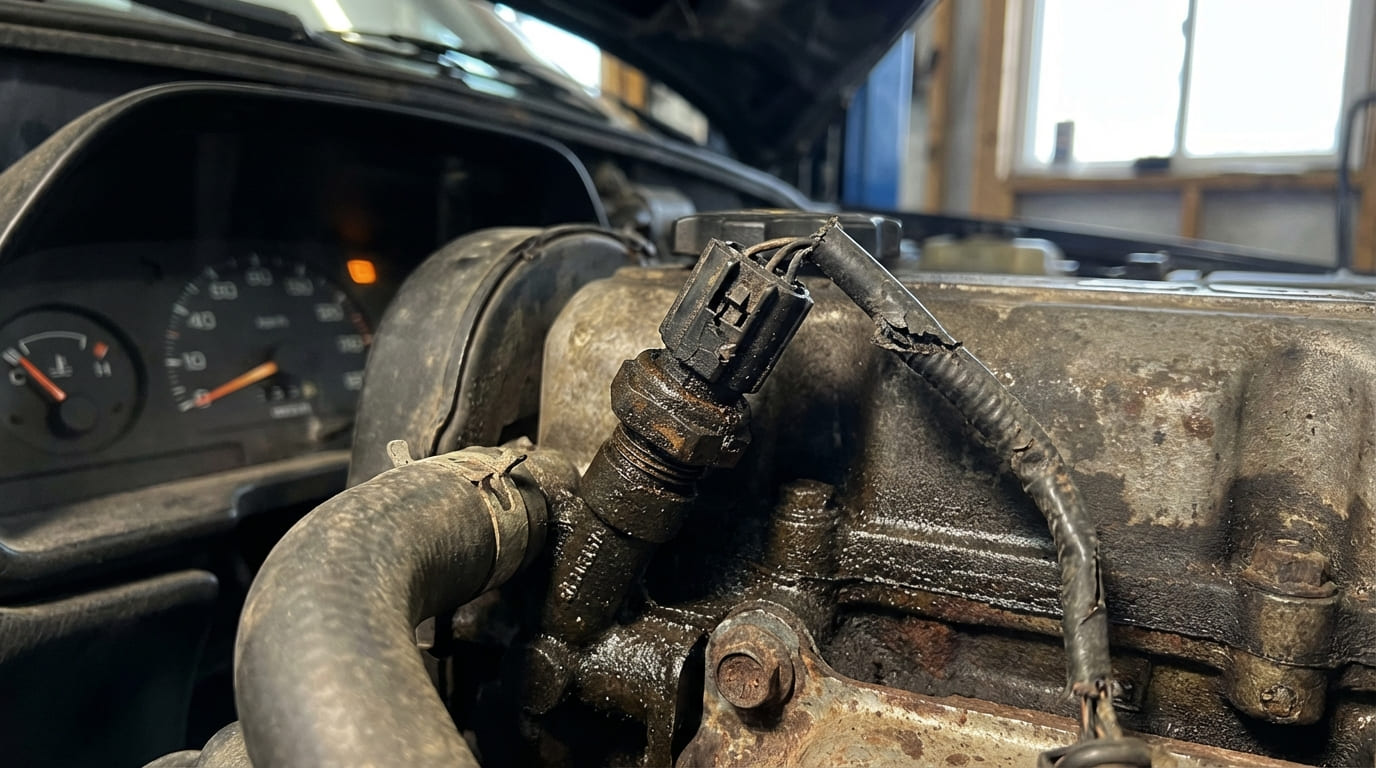
- Remove the upstream O2 sensor (pre-catalyst) on the bank you’re testing.
- Screw the backpressure gauge into the sensor port by hand, then tighten slightly with a wrench (don’t overtighten).
- Start the engine and let it idle.
- Record pressure at idle (should be under 1.25 PSI).
- Repeat at 3,000 RPM if safe and accessible.
Gradually increase RPM to 2,500 and hold for 30 seconds. Record the reading.
Interpretation:
- Less than 2.5 PSI at 2,500–3,000 RPM: No significant restriction.
- Over 3 PSI: Indicates blockage. Could be the converter, but also check for collapsed muffler or foreign object.
Pro tip: After high-RPM testing, quickly remove the gauge. If you hear a strong rush of air, that confirms restriction. But remember—high backpressure can also come from turbo or EGR issues on diesel engines.
Infrared Temperature Test (Check for Efficiency)
A healthy catalytic converter generates heat through chemical reactions. Measuring inlet vs. outlet temperatures reveals its activity.
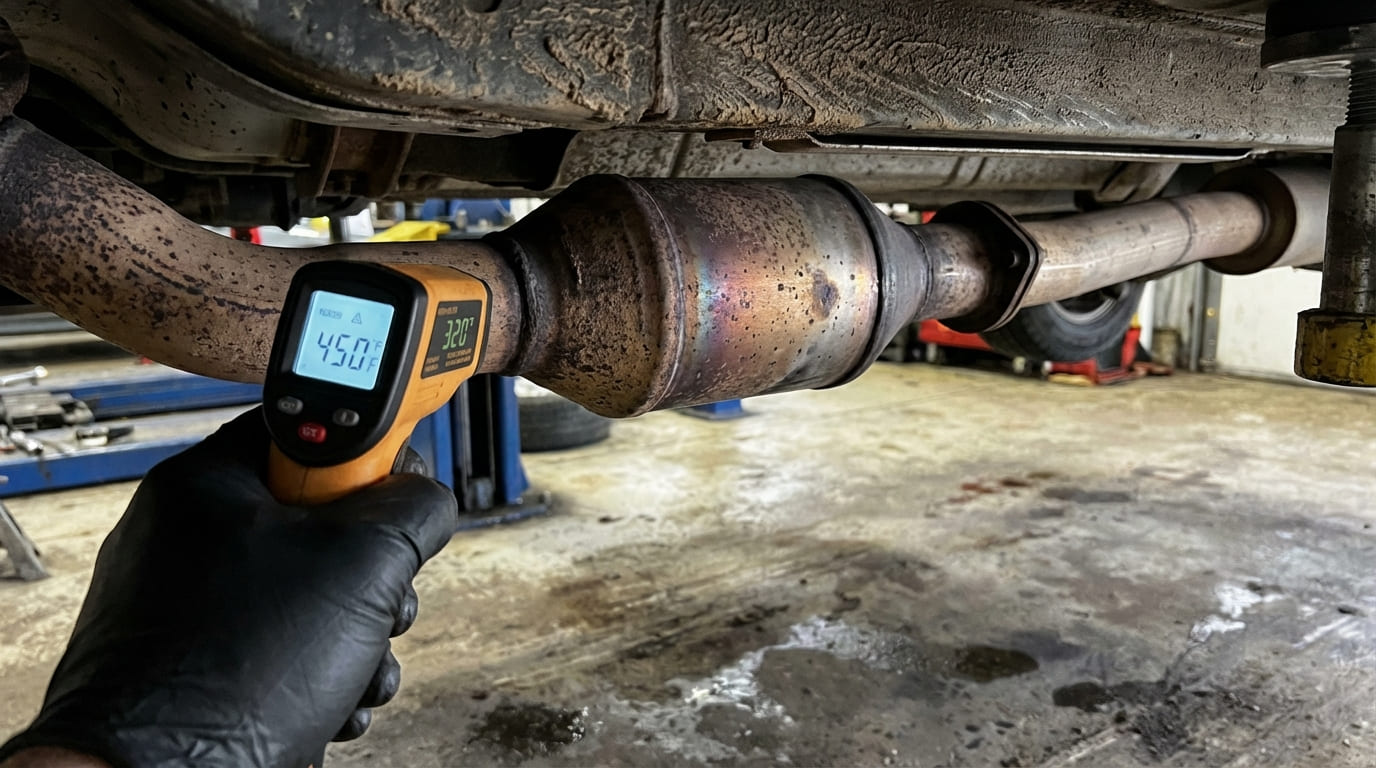
Tools needed: Infrared thermometer with at least 5:1 distance-to-spot ratio.
Procedure:
- Drive the vehicle for 15–20 minutes to reach full operating temperature.
- Measure the front (inlet) of the converter on clean metal.
- Measure the rear (outlet) of the converter in the same way.
Interpretation:
- Outlet 100–200°F (55–110°C) hotter than inlet: Normal operation.
- Outlet temp equal to or lower than inlet: Converter not reacting—likely degraded or contaminated.
- Entire unit glowing red: Severe overheating due to unburned fuel—check for misfires.
Surface coatings and airflow can skew readings. Take multiple measurements and aim for bare metal.
OBD2 Live Data Analysis (Monitor O2 Sensors and Fuel Trims)
Use a scan tool to observe real-time sensor behavior. This is one of the most accurate ways to assess converter efficiency.
Procedure:
- Connect OBD2 scanner with live data capability.
- Monitor upstream (B1S1) and downstream (B1S2) O2 sensors at idle and steady 2,500 RPM cruise.
- Observe fuel trims (STFT and LTFT) across operating conditions.
Interpretation:
- Upstream O2 sensor should cycle rapidly (0.1V to 0.9V).
- Downstream O2 sensor should be stable (around 0.6–0.8V) with minimal fluctuation.
- If downstream sensor mimics upstream cycling, the converter isn’t storing oxygen—suggesting failure.
- If LTFT drops below -15% at higher RPM, it may indicate exhaust restriction limiting airflow.
Warning: A lazy or faulty downstream O2 sensor can mimic converter failure. Test sensor response independently if possible.
Visual Inspection (Quick but Critical)
Lift the vehicle safely and inspect the exhaust system:
- Look for dents, cracks, or impact damage to the converter shell.
- Check for blueing or warping—signs of overheating.
- Inspect for exhaust leaks near the manifold, flanges, or O2 sensor ports upstream of or near the downstream sensor.
- Verify hangers are intact—broken mounts can stress the converter.
A leak before the downstream O2 sensor introduces extra oxygen, making the converter appear inefficient even if it’s working.
Step 3: Cross-Reference Results and Make a Decision
No single test is definitive. Combine findings to reach a reliable conclusion.
Diagnostic Decision Table
| Symptom / Test Result | Probable Causes | Recommended Next Step |
|---|---|---|
| P0420 + stable downstream O2 sensor | Actual converter degradation, aging, or contamination | Proceed with temperature and backpressure tests |
| P0420 + downstream O2 sensor cycling rapidly | O2 sensor fault, exhaust leak, or misfire | Inspect for leaks, test O2 sensor, check for misfires |
| High backpressure at 3,000 RPM (>3 PSI) | Clogged converter, collapsed muffler, or blockage | Retest after removing upstream O2 sensor; inspect full exhaust |
| Outlet temp ≤ inlet temp | Catalyst depleted, substrate melted, or engine running too rich | Check fuel trims, inspect for misfires, verify O2 data |
| Rattling noise from converter | Broken substrate—mechanical failure | Replace converter; investigate cause (detonation, overheating) |
Situation: A 2012 Camry with P0420 and sluggish acceleration. Customer replaced upstream O2 sensor—no fix.
Diagnosis: Backpressure was 4.0 PSI at 2,500 RPM, but LTFT was -18% at cruise. Smoke test revealed a small intake leak.
Fix: Sealed the leak. P0420 cleared after drive cycle. Converter was fine—lean condition fooled the system.
Situation: Truck with red-hot converter and sulfur smell. Ran fine otherwise.
Diagnosis: Live data showed constant misfire on cylinder 5. Ignition coil was arcing to ground.
Fix: Replaced coil. Converter cooled down. No replacement needed—the cat was a victim, not the cause.
Situation: Minivan with P0430 and poor fuel economy. Temp rise was only 30°F.
Diagnosis: LTFT at +25%. Fuel pressure test revealed restricted return line—engine running rich.
Fix: Cleared fuel line. Efficiency returned. Converter wasn’t faulty—just overwhelmed.
Final Checklist: Avoid Costly Mistakes
- ✅ Fix engine problems first: Misfires, vacuum leaks, or fuel issues will destroy a new converter.
- ✅ Inspect for exhaust leaks: Even small leaks near sensors can trigger false codes.
- ✅ Test downstream O2 sensor: A failing sensor mimics converter failure—replace it before the cat.
- ✅ Use multiple tests: Combine backpressure, temperature, and live data for confidence.
- ⚠️ Never replace based on P0420 alone: It’s the most overused justification for an expensive repair.
- ⚠️ Avoid catalytic cleaners: They don’t restore efficiency and can foul sensors.
- ⚠️ Don’t rev to “clear” a clogged cat: Risk spreading debris or damaging muffler.
After two decades in the shop, I’ve learned: the catalytic converter is rarely the root cause. It’s usually the last component to fail in a chain of engine issues. Test thoroughly, interpret data in context, and always consult factory specifications for backpressure and temperature limits. A proper diagnosis protects your wallet and your engine.