Water pump replacement costs vary widely—from $250 to over $1,000—depending on your vehicle and whether you DIY or hire a shop. As a master mechanic, I’ve replaced hundreds of pumps across all makes and engine types. The real cost isn’t just the part; it’s access, labor time, and what else needs replacing while you’re in there. This guide cuts through the noise and gives you exact cost breakdowns, diagnostic checks, and real-world advice to avoid costly mistakes.
Average Water Pump Replacement Cost
Most replacements fall between $250 and $1,000. But that range hides critical details. A simple belt-driven pump on a compact car might cost $300. The same job on an interference engine with a timing belt can hit $900 or more. Here’s how the numbers break down.
Professional Replacement Cost
Labor and parts are the two main cost drivers. Location and shop rates also matter—urban shops charge more per hour than rural ones.
| Cost Component | Price Range | Notes |
|---|---|---|
| Labor | $200 – $800+ | 2.5 hours on easy-access engines; 6–8 hours if timing cover, intake, or subframe must be removed |
| Water Pump (OEM) | $150 – $400 | Factory-specified fit and material; recommended for aluminum blocks and high-heat engines |
| Water Pump (Aftermarket) | $50 – $250 | Quality varies—stick to brands like ACDelco, Gates, or Bosch for reliability |
| Coolant | $20 – $50 | Must use correct type: OAT, HOAT, or IAT. Mixing causes sludge |
In my shop, we always quote the full job—including thermostat, timing belt, and coolant—because doing it twice costs more. If labor is already $600, adding a $180 timing belt kit saves the customer $400 in future labor.
DIY Water Pump Replacement Cost
DIY can cut costs in half—if you have the tools and know-how. But don’t underestimate hidden expenses like specialty tools or coolant disposal.
| Cost Component | Price Range | DIY Notes |
|---|---|---|
| Water Pump (OEM/Aftermarket) | $50 – $400 | No markup, but quality still matters. Skip the $60 no-name pump on a high-mileage engine |
| Coolant | $20 – $50 | Buy pre-mixed if unsure about ratios. 50/50 is standard |
| Tools (if not owned) | $50 – $200 | Torque wrench, radiator pressure tester, timing tools may be needed |
Essential Tools for DIY Replacement
Having the right tools prevents damage and ensures a lasting repair. Missing one can turn a weekend job into a tow.
- Torque Wrench (3/8″ drive): Critical for water pump and housing bolts. Over-tightening cracks aluminum housings.
- Coolant Drain Pan (2+ gallons): Most systems hold 6–12 quarts. Use one with a spout for clean disposal.
- Radiator Pressure Tester ($50–$150): Test for leaks after refill. I use mine on every coolant job—catches bad caps and tiny hose leaks.
- Timing Tools (if applicable): Cam locking pins, crank pulley holder, tensioner tool. Rent or buy kits for $30–$80.
- Plastic Gasket Scraper: Clean mounting surfaces without gouging aluminum. Steel scrapers cause leaks.
On a 4-cylinder Toyota, I’ve done a pump swap in 3 hours with basic tools. On a transverse V6 Ford, it took two days—intake off, subframe dropped, and a trip to the parts store for a broken bolt extractor. Know your engine’s reputation before starting.
Key Factors That Affect Total Cost
Two cars can have the same engine—but wildly different labor times. Here’s what drives the real-world cost.
Engine Layout and Pump Location
Front-mounted, serpentine-driven pumps are easy. Timing cover pumps on interference engines? That’s where costs spike. Electric pumps are simpler to unbolt but may need programming with a scan tool.
Concurrent Repairs: What to Replace Now
If labor is already high, replace related parts. It’s cheaper now than in six months.
| Component | Cost (Part Only) | Why Replace With Pump |
|---|---|---|
| Timing Belt Kit | $150 – $400 | Pump is often driven by the belt. One failure can destroy the engine. |
| Thermostat & Gasket | $15 – $50 | |
| Serpentine Belt | $20 – $60 | |
| Tensioner & Idler Pulleys | $30 – $100 each | |
| Coolant Hoses | $10 – $40 each |
I’ve seen customers save $200 on a pump job—then come back three months later for a $700 timing belt replacement. If the pump is behind the belt, do both. It’s not overkill—it’s smart.
How to Diagnose a Failing Water Pump
Don’t replace the pump blindly. Confirm it’s the culprit first. Many symptoms mimic other failures.
Check 1: Inspect the Weep Hole
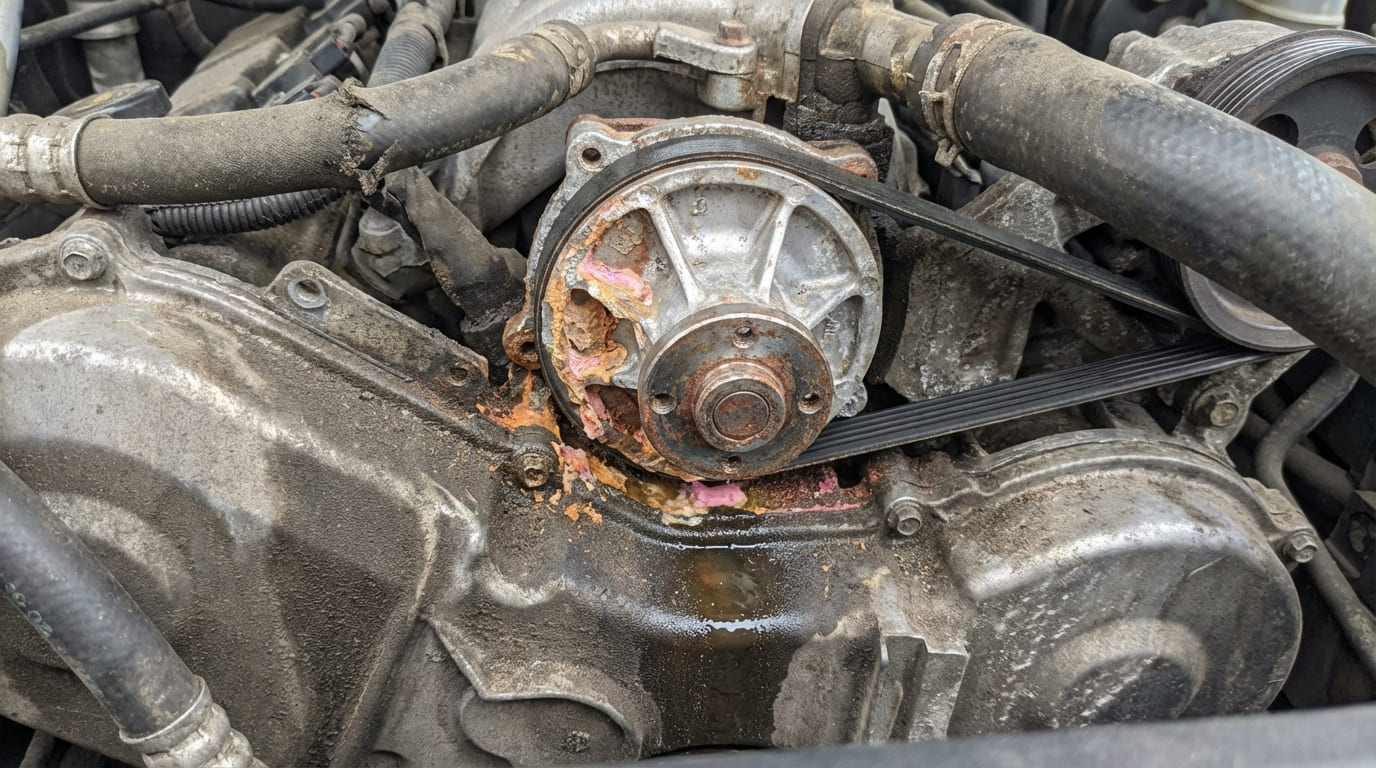
Locate the small hole at the bottom of the pump housing. Wetness or dried coolant streaks mean the internal seal is failing. Dry? The pump may not be the issue.
Check 2: Listen for Bearing Noise
Use a mechanic’s stethoscope or long screwdriver against the pump body. A grinding or growling noise means bad bearings. But test idler pulleys and tensioners too—noise travels.
Check 3: Monitor Coolant Temperature
Use an OBD2 scanner to read live coolant temp. If it climbs under load but fans work, flow may be low. Compare inlet and outlet radiator temps with an infrared gun—more than 20°F difference suggests poor circulation.
Check 4: Verify Coolant Flow
Warm engine to operating temp (thermostat open). Carefully remove radiator cap. Look for steady flow in the radiator neck. No movement? Could be failed pump, airlock, or stuck thermostat.
I once tore into a pump on a Subaru only to find the thermostat was stuck closed. Always test the cheap, simple things first. Save the big job for when diagnostics confirm it.
Can You DIY This Job?
It depends on your skill and the vehicle. Here’s how to decide.
DIY-Friendly Jobs
Front-mounted pumps driven by the serpentine belt are usually doable for DIYers with basic tools. Examples: 4-cylinder Honda, older Ford 4.0L, GM Ecotec. If you can see and reach the bolts without removing brackets or manifolds, it’s a green light.
Leave It to a Pro
If the pump is behind the timing cover, especially on an interference engine (most Hondas, Toyotas, Fords), skip it unless you have experience. One timing error can bend valves. Electric pumps on modern Fords and GMs may need module coding. Intake manifold removal? That’s a pro job—too many gaskets and sensors to risk.
My rule: If the repair requires torque-to-yield bolts, timing alignment, or ECU programming, and you’ve never done it before—pay for labor. The cost of a mistake far exceeds the savings.
Post-Replacement Checks: Don’t Skip These
Installing the pump isn’t the finish line. Verify the repair to avoid comebacks.
Pressure Test the Cooling System
Pump to 15–18 psi (cap rating) and hold for 15–20 minutes. Any pressure drop means a leak. Check hoses, radiator, heater core, and the new pump seal.
Run Engine and Monitor Temperature
Warm to operating temp with live OBD2 data. Coolant temp should rise steadily, stabilize, and cycle with thermostat. No spikes or slow climbs.
Check for Leaks Under Pressure
Inspect the weep hole, gasket, and hose connections with the engine hot. Some leaks only appear when components expand.
Test Heater Output
Turn heater to max. Both heater hoses should be hot. If not, air is trapped. Follow the vehicle’s bleeding procedure—some need a bleeder screw opened or a scan tool to run the pump.
What to Do and What to Avoid
- ✅ Do: Clean mounting surfaces with plastic scraper and brake cleaner. Even a thin film of old gasket causes leaks.
- ✅ Do: Use new bolts or clean old ones with a thread chaser. Dirty threads give false torque readings.
- ✅ Do: Replace the thermostat. It’s cheap and fails around the same time.
- ⚠️ Avoid: Reusing torque-to-yield (stretch) bolts. They lose clamping force and can lead to leaks or breakage.
- ⚠️ Avoid: Mixing coolant types. OAT (orange) and HOAT (yellow) don’t play well together—causes gel and corrosion.
- ⚠️ Avoid: Skipping the pressure test. I’ve seen new pumps leak from shipping damage or bad gaskets.
Real-World Failure Cases and Lessons
| Symptom | Most Likely Cause | Less Common Causes | Diagnostic Step |
|---|---|---|---|
| Coolant leak at weep hole | Internal seal failure | Cracked housing, abrasive coolant debris | Inspect pump body; flush system if debris found |
| Grinding noise from front | Water pump bearing wear | Idler pulley, tensioner bearing | Remove belt and spin each pulley by hand |
| Overheats under load | Impeller damage or cavitation | Air pocket, clogged radiator, stuck thermostat | Check flow at radiator; verify thermostat opens |
| No cabin heat | Air in system, low coolant | Clogged heater core, failed valve | Bleed system; check heater hose temps |
Situation: 2010 Honda Accord overheating, white smoke—assumed head gasket.
Discovery: Head and block were flat. Pump impeller was warped plastic—common in older Hondas. Flow was reduced by 60%.
Lesson: Not all overheating is a blown gasket. Check pump flow before pulling heads.
Situation: 2008 Camry with whining noise—pump replaced twice.
Discovery: Idler pulley bearing was failing. Noise mimicked pump.
Lesson: Isolate noise source. Never replace a pump based on sound alone.
Situation: 2012 Ford Fusion leaking after pump replacement.
Discovery: Old gasket residue on block created uneven seal.
Lesson: Clean mating surfaces like you’re prepping for paint. It takes 10 minutes and prevents leaks.
Water pump replacement isn’t just about the part—it’s about the system. Diagnose first, bundle repairs wisely, and never skip verification. Whether you DIY or hire a shop, knowing the real costs and pitfalls puts you in control. Always consult your vehicle’s service manual for torque specs, coolant type, and bleeding procedures. The difference between a fix that lasts and one that fails is in the details.